
I’ve been obsessed lately about holes in brick walls.
In the 116-year-old building I work in, there are a lot of them. It seems like every one has a story.
This building was first occupied in 1906, four years before my oldest grandparent was born. It’s along the river and part of this region’s long industrial history, a remnant of what the Rust Belt used to be since the beginning of the Industrial Revolution.
That industry, which literally built and powered the United States in the 1800s and 1900s, is a shadow of what it used to be.
The city I’ve lived in for the past decade or so has a storied history, famous sports teams, and an innovation and eds & meds economy that has helped imagine a future.
Gradually, even in the time that I’ve been here, pieces of that industrial history have been refurbished and given new life. This building is certainly like that. It was a 500,000-square-foot, six-story cargo terminal, next to a cement plant and other industry, for decades. Then it was acquired by a commercial real estate company, noted in this city for their innovative work, and it’s been slowly transformed into a series of offices.
We’ve only been here a year and I’ve been here less than that, since we didn’t go back to the office until May 2022, more than two years after we and most white-collar workers were forced out from the Covid-19 pandemic. But it’s been a joy to work here, not only for the refurbishment that will ultimately cost $100 million when it’s all done, but also because of the building’s character.
It’s terrific. There are so many nooks and crannies and even though I’ve only been on the ground floor, the first level and the floor my office is on, I’ve appreciated what I’ve seen.
Now to the holes.
There’s brick everywhere, mostly painted over white, and bubbly and bulging, depending on the condition of the mortar and the bricks themselves. And there are holes in the bricks, some large, some small, all over the place. There doesn’t seem to be a rhyme or reason for most of them, although some of them clearly had important use that is still apparent today.
Even if they are just holes.
But others, it’s hard to tell. And I’ve been wondering.
Like this hole. It’s small enough for me to put my finger in — I have pretty small fingers — but I can’t seem to put my finger in what it’s for. It’s not bothering me, per se, I’d love to know more. What did this space look like before 2016, when the building was bought? What happened here, what kind of work and how many people, in all the decades between 1906 and 2016?
And whatever was in the hole, and all the holes, what happened to them?
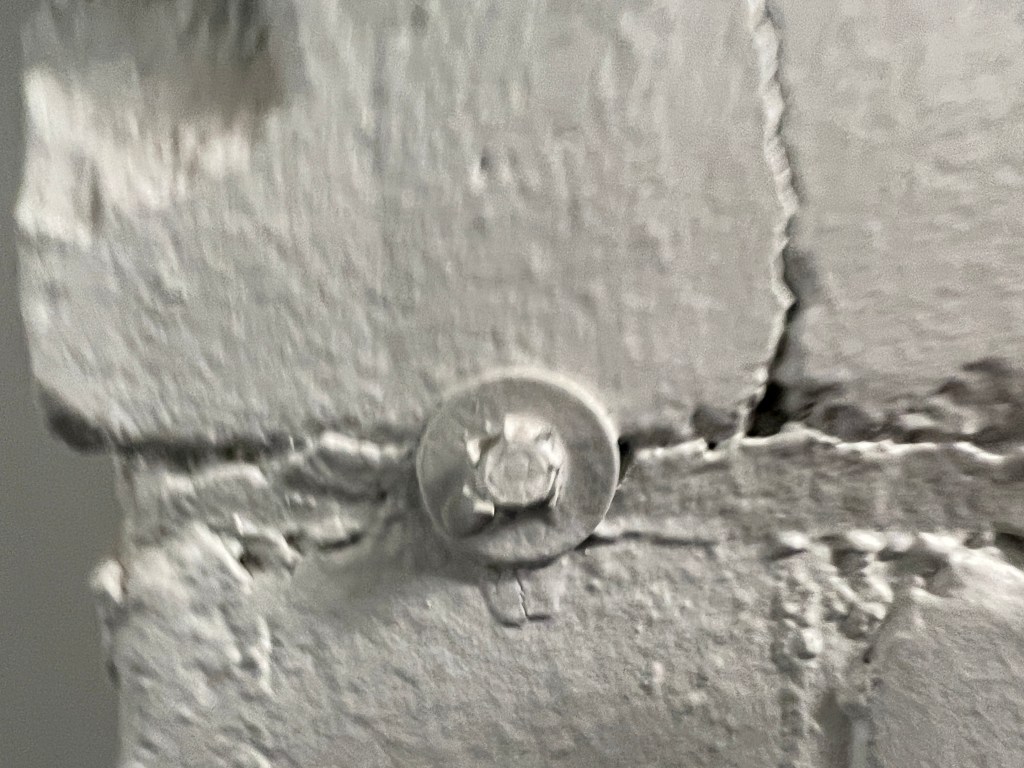
There are a few clues. I was walking back to the office a few hundred feet away, sort of taking notice of all the holes that up until recently I had just sort of passed by. Then I saw a washer and bolt orphaned along the brick wall. That’s obviously what was in at least some of the holes.
I sort of wondered why that washer and bolt were left in place. There are a lot of holes and not a lot of bolts.
I don’t have much experience when it comes to old buildings. Most of the places I’ve lived in, including all the way through childhood, were either younger than me or not too much older. My maternal grandparents’ house was older, probably 100 years old by the time I came around, in an old and dignified section of Newton, Massachusetts. And my first newspaper had once been a train station and was modeled on a building in Siena, Italy. But neither had the level of stories, it seemed to me then, that my new/old office building does.
There was one place, however, where I lived in the mid-1990s, that reminds me a lot about this. It’s in Beacon Falls, Connecticut, and before it was converted to apartments in the mid-1980s, it had been some type of mill. Beacon Mill Village still retained that look on the outside, four stories and a little under 200 units, red brick and with some of the mill infrastructure still intact, inside and outside.
I had a two-bedroom, corner apartment there in 1995 and 1996. It was glorious, with 15-foot high ceilings and windows that were almost that tall, floor to ceiling. The carpets were plusher than I had ever seen before, even more plush than my maternal grandparents’ house, which you could sink into. The exposed brick was everywhere, it was buffed and classy, and the inside had been transformed into a chic living space for the 20-something I was. I lived there alone for most of the time I was there.
I didn’t have any particular affinity for Beacon Falls, a small town off the highway between Bridgeport and Waterbury. I worked in Norwalk at the time, about a 45-minute drive on a good day. I actually don’t remember why I moved there. It was closer than living in New Haven, where I did when I worked in Norwalk. But it wasn’t that much closer, and I didn’t at the time have any family within 25 minutes or so. And it was about that far to my graduate school classes in New Haven.
But it was wonderful.
I’ve lived a lot of places. I’ve moved about three dozen times, thanks to my parents’ divorce, my mother’s remarriage to someone who worked for the Navy and got transferred a lot, and then an itinerant newspaper career. But in terms of the bricks and mortar, not taking into account either the loved ones or the location, Beacon Mill Village was the best place I’ve ever lived.
Being in the corner, on the second floor, on the street but not on the main street, helped. It was both quiet and secluded, but not that far away from everything. It was quick to go down the stairs or the elevator to the parking lot. And when it snowed, which it did a lot in that winter, laying on my bed, surrounded by the biggest windows I had ever seen on two sides, the effect was stunning.
I really enjoyed living there.
Plus it was the best kitchen I had, big and modern and I loved cooking at the time.
All around, a great place.
I also enjoyed exploring that building, inside and out. It was historic and yet had all the trappings of modernity, too. It was almost like I could touch, if I looked closely, the history and the people who had been in there in the building’s former life.
I thought of that today when I started looking a little closer at my office building. Beacon Mill Village is red brick and an apartment building in a valley in Connecticut, 400 or 500 miles away from where I live now. I haven’t even been by the place since 2007. I just don’t get back to Connecticut much and if I do, it’s usually on the Merritt Parkway or I-95. Beacon Falls is out of the way.
Anyway, I’ve been thinking a lot of holes in brick walls lately.

 Nows and Forevers
Leave a comment