-
Saving Cymraeg
While I don’t speak Welsh every day anymore, Wales and the Welsh language still hit me in the heart. And this is an important video by Tudor Owen, a Welsh-language comedian and radio host. But he’s not being funny here and that’s what makes it all the more powerful. It’s a few minutes worth watching, if only for the beauty of Wales shining through.
There’s been a steady destruction of the Welsh language and culture over the last 100 years or so (let’s be honest, it goes back centuries longer than that). I joined the defense when I began to learn the language, as I did, in Welsh-language schools out of Merthyr Tydfil, Caerdydd, Abertawe and Sir Penfro. You know, like, America’s favorite, Wrecsam.
Yes, Welsh can be a difficult language. My primary tutor told me, no exaggeration, that Welsh is the language of heaven and I believe it. I’ve understood thoughts and feelings in the language that I can’t convey in English. And even years of French, and living in a bilingual French/English community, never gave me the same kind of immersion.
Cymraeg is beautiful, yes, but it’s also an ancient language full of mystery and wonder. Even in its place names possess distinctiveness.
“So it’s not just a name, it’s a story,” Owen said. He’s right.
-
The long arm of Titanic
Here’s the link:
https://www.bbc.com/culture/article/20240412-in-history-the-man-who-survived-the-titanic-sinking
It’s hard to imagine more than be said about the Titanic but here’s the witness of Frank Prentice, one of the few surviving crew members of the Titanic, of this night in 1912 from 67 years later:
“I shall probably dream about it tonight; have another nightmare. You’d think I’m too old for that, but you’d be amazed. You lie in bed at night and the whole thing comes round again.”
-
Why I’m not going to chase a fourth eclipse
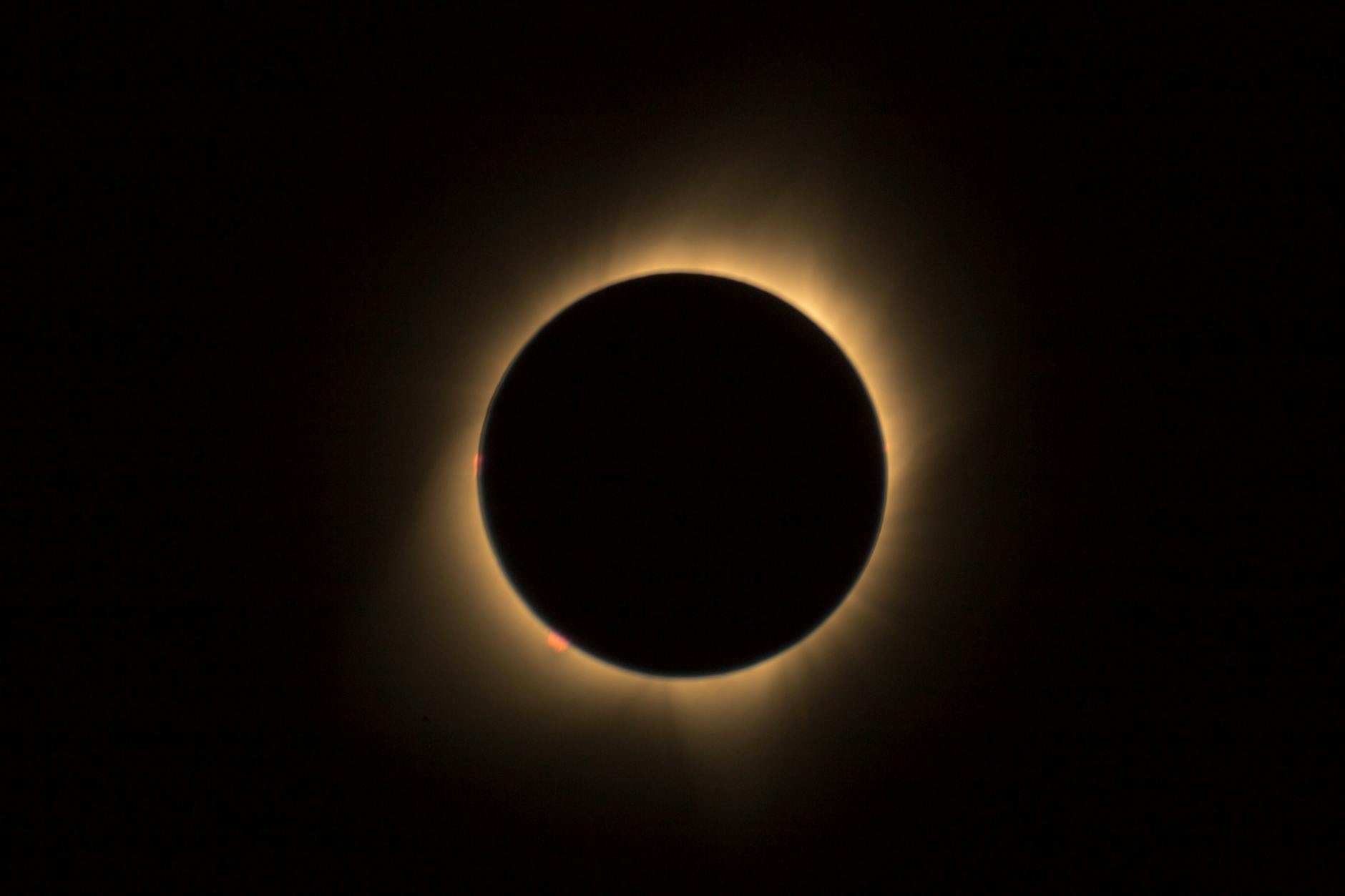
Photo by Drew Rae on Pexels.com I am three and done. Monday afternoon was the third solar eclipse of my life: The first was in May 1994, 30 years ago next month, when I was under a partial eclipse in the early afternoon in Bridgeport, Connecticut. I always wanted to see a full solar eclipse, and I finally got my chance in August 2017 when I drove about eight hours for 55 seconds of totality in Bowling Green, Kentucky.
It was everything I thought it would be and more. Immediately, I knew I had to see another one and it felt like 2024 would be a long, long time to wait. And it was, but there was a benefit to the Great American Eclipse of 2024: I only had to drive two hours from where I live now to see 3 minutes and 24 seconds of totality.
It was, once again, awesome. It was a different feeling, to be sure. I had already seen totality, felt and seen the sun ebb, watched the shadows fall and then darkness erupt around me. It was vivid, if less than a minute, in 2017. I had three times as much totality Monday and yet it felt short, somewhat rushed. I’m glad I went and it was an experience I’ll never forget. But I don’t have the same feeling as I did seven years ago. It’s hard to explain. I was happy I saw it, felt privileged to be alive in this moment, and wished a little bit I had been able to see it not in a neighboring state I care little about but in a place that meant something to me.
That’s because the final moments of the eclipse in 2024 actually fell in a place that means a lot to me, where I used to live and where I still have strong memories. I actually thought about going back to see it there, but decided against it. Why go so far when it’s already so close to where I live?
Reading the Facebook forums about the eclipse, many can’t wait to see another one. They’re making plans to go to one or the other of the next ones, in Spain and Egypt. But as much as I loved the experience and can say I have seen three eclipses, I don’t have any desire to see another one. And the next one in my hometown in Connecticut is in the latter part of this century, and I’m not going to live that long to see it.
I’m fortunate. Three eclipses are three more than most people get. Other than my father, who went with me in 2017, I don’t know of anyone in my immediate family to ever see one. I’m sure that my great-grandparents could have seen the 1925 one, which was where they lived in Scranton, Pennsylvania, and Boston, Massachusetts. It cut a path from Scranton, Pennsylvania, through the Hudson Valley of New York through Connecticut, that corresponds to more than two-thirds of my life and four generations
I’m sure my grandparents and my mother never got to see one.
But that’s it. And that’s more than four minutes of totality, two separate times where I got to see the sun rise and set twice in one day, actually within the space of several hours. I got to share both totalities with special people in my life. I saw God’s handiwork and it was, like all things, Good.
Yet I don’t desire to see another one.I have the memories. That’s enough.
-
Full totality, but not the typical shot
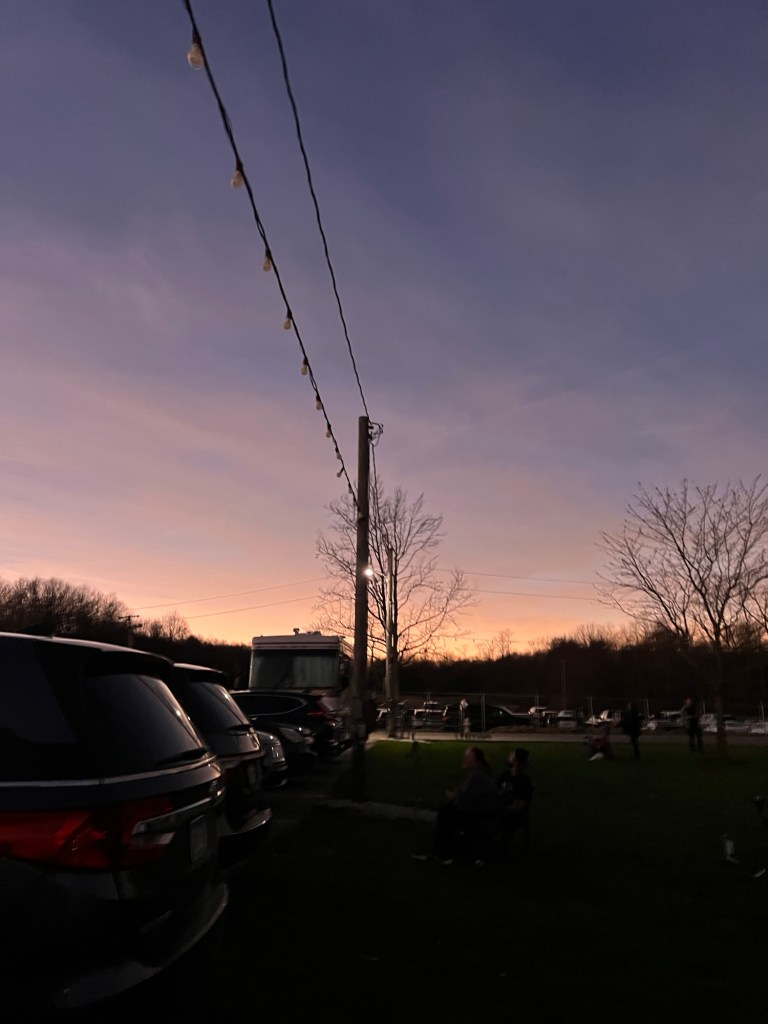
No photo of totality with my iPhone, but I had a minute or two to snap the first of two sundowns that day.. Unlike last time around in 2017, I didn’t get a photo of totality. I figured I would just enjoy the experience, just like Bill Nye suggested.
And you know what, I’m not in the least bit upset. It was an awesome experience, even without the photographs that so many others got. And it’s one I’ll never forget.
I did bring my dSLR and, of course, my iPhone. But I quickly realized I didn’t want to spend the time fiddling with the Nikon and the quick swipe at totality with the iPhone didn’t work. And it was cool. I spent almost the entire 55 seconds in 2017 taking photos and didn’t get a chance to really enjoy it.
This time around, I had more than 3 minutes. I could breathe a little easier not being worried about whether the technology was going to work and just experience totality, well, totally.
And, along the edges, some of the other cool sights.
-
A little bit early for totality ..
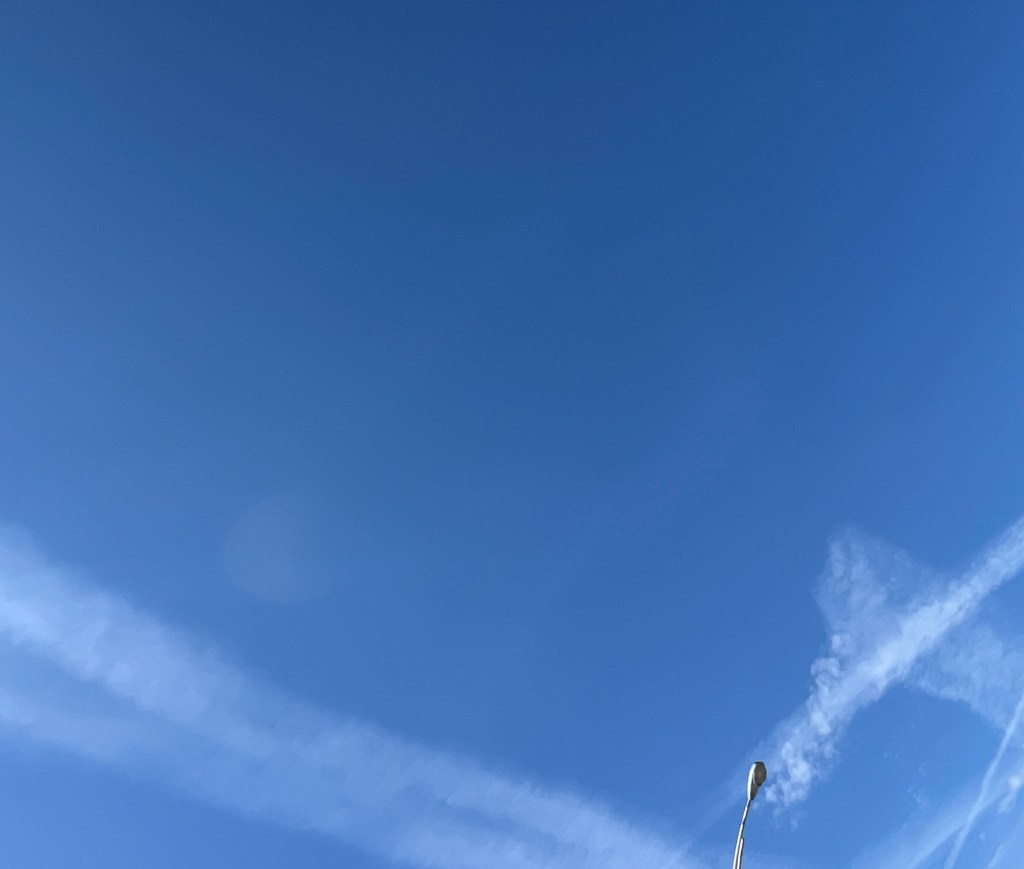
A little bit early of course but the skies in western Ohio are just about perfect, high cirrus and contrails. I feel like that’s as good as it’s going to get. And unlike my former stomping grounds of Aroostook County, Maine, it’s 70 degrees and no snow anywhere.
That being said, kudos to northern Maine. You won the eclipse jackpot, and I am so happy for you.
-
Weathering the eclipse
I haven’t looked at weather maps this hard since two trips ago to the UK OR the last total eclipse of the sun, when I changed my plans at the last minute and went to Kentucky instead of South Carolina.
This time around, I’m hoping to go two hours’ north or northwest to either northwest Pa., or maybe Ohio south of Cleveland. That way the traffic won’t be as much trouble. But … a big factor will be cloud cover. I’m also open to western New York although I really don’t want to drive that far.
Certainly a first-world problem.
-
Torment into beauty
For my money, one of the most touching scenes in all of “Doctor Who,” with Bill Nighy walking on with brilliance to honor Vincent Van Gogh: “He transformed the pain of his tormented life into ecstatic beauty. Pain is easy to portray, but to use your passion and pain to portray the ecstasy and joy and magnificence of our world … No one had ever done it before. Perhaps no one ever will again.”
Happy birthday, Vincent Van Gogh.
-
Do you remember the good old days?
The Specials, as always, coming in hot and perfectly timed for the late ‘70s and early ‘80s. Turns out this is the late Terry Hall’s birthday.
-
Remembering Jimmy Breslin
Listening to WCBS on the way into work this morning and Wayne Cabot mentioned today was the anniversary of Jimmy Breslin’s passing. Growing up in the New York metro area and reading the papers, you could read a lot of Jimmy Breslin. I did.
Breslin was one of the journalists I grew up reading, wanting to emulate as a street reporter, and who I have kept coming back to, over and over again. When I have taught journalism, in class and also as an editor, I’ve used Breslin’s work. Yeah, I’m a huge fan. And I’ve made at least one other Breslin fan who thought just as highly of his work.
(And there’s now a Library of America collection of Breslin’s newspaper and magazine articles and two of his books, which I highly recommend.)
Read Breslin’s columns in the paper as a kid (til he went to Newsday, which was hard as heck to find in Connecticut) and his book about the Mets. I happened upon his JFK columns as a teenager and it was like lightning struck, not just the writing and who he chose to talk to, but how you went about choosing sources and stories. “It’s an Honor” is still one of the best things I’ve ever written in newsprint.
I saw him speak about it back 26 years ago next month at the late, lamented National Writers Workshop in Hartford, Connecticut, back when we used to talk a lot about improving and celebrating newspaper writing as a craft. I know the exact date because I took notes and I couldn’t wait to unload them into my journal. There, in Hartford, Breslin spoke about the gravedigger theory he’s so famous for. This is directly from my journal, what he said:
“I don’t know many other ways to do my business. I think the best way today would be to take half the phones out of every city room, because you’re dead with stories done on the phone. You’re not going to hold my interest. There has got to be some chemistry and that has to come from the reporter talking to the person involved, face to face, getting those really odd facts that really make the story.”
Even now, 34+ years into my journalism career, I’d rather see someone face to face than get it on telephone or Teams or email. That’s what the job is, or should be.
According to Jimmy Breslin, who did it better than just about anyone else.
-
31 years
It’s been 31 years since the bombing of the World Trade Center on a late February afternoon in 1993. Like 9/11 eight years later, from this vantage point I find it so difficult to believe so much time has passed.
I was working about 40 miles away at a newspaper outside New York City, and heard about it on WCBS Newsradio 88 as I drove from assignment to assignment. These were the days before the cell phone, so I knew my first duty was to rush back to the newsroom to see what we needed to do. For reasons I don’t really understand, our newspaper decided to cover it mostly from wire reports and one reporter.
That didn’t make sense, given the surety there were people from our coverage area who were either working at the World Trade Center or the Financial District every day. Dozens of commuter trains piled into Grand Central station from our area every weekday, not to mention the people who drove. I was only a reporter, I didn’t drive the coverage. I just went where they told me to go.
And they didn’t want us to go.
It would be a few months later, on a big story in our city, that I would decide to follow my own instincts. But that’s another story.
The ’93 WTC attacks get lost in history, I’m afraid, because of the sheer scope of 9/11 and how many people it killed and how the aftereffects still reverberate today. I know it does for me, as I lived closer and worked closer and actually covered 9/11 and its aftermath in 2001 and in the years afterward for several papers. Sept. 11 wasn’t just the biggest story I would ever cover, it was also personal. Like most everyone in the New York area, we had a personal connection.
It’s still personal. It’s not performative saying #neverforget. Because we never will.
Remember what happened 31 years ago today, that’s important too. It was one of the first times I remember thinking that terrorism was more than just something that happened overseas. I knew that for years, for a girl my age from my hometown was killed in the bombing of Pan Am Flight 103 on Dec. 21, 1988. But I guess I was too naive to think it couldn’t happen here. Then the ’93 bombings, which killed six people. Two years later, the domestic terrorism in Oklahoma City.
And then Sept. 11.
I moved to another state about a decade after 9/11, but it’s remained in my heart and my head. I listen to the reading of the names every year until one in particular, and I never miss it, no matter what. It’s crucial we remember them. And it’s crucial we remember those we lost, 31 years ago today.
We must never forget.
Home
About Me
Journalist and writer. Loves writing, storytelling, books, typewriters. Always trying to find my line. Oh, and here’s where I am now.


Leave a Reply