-
To app or not to app
I’ve got a love/hate relationship with apps.
I’m glad I’ve got some of my favorites – Day One and Drafts chief among them — within easy reach, whether it’s on my iPhone, my iPad or MacBook. (Yes, I’ve been Apple-only for at least a decade.) I love to write on Scrivener and Byword. I like being able to watch streaming video services, and even YouTube, wherever I am. And I can scan PDFs and take pictures in archives, which is a lifesaver as I work on my book.
The iPad is also pretty purpose fit for reading, although I still like my Kindle.
But I’ve gone through dozens, maybe hundreds of apps since I got my first iPhone 15 years ago, then added an iMac and iPad more than a decade ago. For a while, it felt like the very app I needed was just within reach. Like Kindle books, most just ended up piling up.
I should say that I don’t have a lot of games. For some reason, and I don’t know why, I don’t have the gene for gaming. It’s not a way I like to spend my time, other than when the kids were young. I might have a half-dozen games, all discarded long ago. The only one I enjoyed really was a retread from the ’90s and early 2000s, “You Don’t Know Jack.” And those aren’t even on iOS anymore. Oh, and Microsoft Flight Simulator.
No, my problem is that I am sometimes obsessed by productivity tools, always eager to try a new writing app (I’m not gonna call it word processing), and whether I was interested in aviation, meteorology, or the Welsh language, well, there’s an app for that. And I’ve been looking into a new wave of apps as I try to store and harness the thousands upon thousands of articles, notes and PDFs for this book project. That’s another story.
But I don’t use most of them, or long since ditched them. While I’d like to have that money back, it is what it is. But I hate moving back and forth between iPhone screens, even with folders. So I committed myself to cutting back on apps, moving them out when they’re done (like a hotel or airline app after the trip). So I only keep two pages on the iPhone, with separate folders for Productivity and Entertainment.
I prune the apps regularly. I have even fewer on the iPad.
It’s a little more difficult on the Mac. I’ve never found an elegant solution for the apps other than the list, which stretches to two pages on its own. I move those in and out, too. And since I started working with Obsidian and upgraded Aeon Timeline, I’ve added one or two.
I’m resigned to adding a few right now. But I’m not sure. -
On the thin margin
Life can be a matter of inches.
The difference between a grand slam and a foul ball. Whether your eyes meet with the love of your life, or she passes by, a face in the crowd. Or the narrow space between a high-speed crash or driving off unscathed.
We walk around knowing that, often saying “there by the grace of God go I.” Living to an old age is miraculous, given that for most of human history the Earth and life itself was inhospitable. The Covid-19 pandemic taught us that again, when a tiny virus meant a matter of life and death for untold millions across the globe.
Life taught me that lesson yesterday morning, when I was on the far end of a vicious multicar crash on the interstate highway on my way to work. I was within an inch or two of being struck by a vehicle tumbling out of control, a cacophony of metal and dust that breezed by my rear-view mirror between my car and the SUV behind you.
It happened so suddenly, it was hard to register what was happening. Until I glanced over at the grassy median and saw an SUV on its side.
What I didn’t know was the whole picture. I pulled over into the right lane and then over to the side of the highway. I called 911, told them to come quick. I described the car on its side, a few other cars behind me. I said I think I knew what happened, at least in the beginning, and would stay for the state cop to arrive.
Then I headed out of my car and across the highway, where the cars and trucks slowed but didn’t stop. The woman behind me had stopped, essentially where the crash happened. Her car was clipped in the back by another car that didn’t stop. A sedan sat in the breakdown lane, with front-end damage. The 20-something guy behind the wheel was shaken up but unhurt; the woman behind me wasn’t hurt either. She was amazing, helping to get the couple in the tumbled SUV out of their car and then tending to their minor wounds. Turns out she went to high school with the driver and his wife.
We were both just glad the couple whose car had smashed into the median weren’t hurt badly. When I called 911 I feared the worst. It’s nice to see when the worst doesn’t happen.
We each knew a piece of what happened.
In the front of the line, I had a few moments before the accident saw a black sedan screaching past me in the righthand lane, perhaps trying to get out of the traffic conga line. The car suddenly changed lanes, about three cars in front of me, and abruptly slid into a cars-length space. The cars behind, already going a little bit over the speed limit in the travel lane, tapped and then more urgently hit the brakes. I had some room behind me so I didn’t stop so abruptly until the second set of brake lights.
What a jerk, I thought. It didn’t seem necessary to swing from the right to the left lane, moving so fast.
I had just slowed and put my foot on the accelerator when a gray SUV tumbled through my back mirrors and landed in a pile of dust I could see, even thought it wasn’t sunrise yet.
It was inches from hitting me, that I knew. I didn’t know the rest but I knew I needed to call it in, needed to stay. Turns out that it was only the four of us. The car that cut in front probably wasn’t aware of the crash. The cars in front of me and around me, other than the woman in the SUV directly behind me, drove off. It turned out to be just her and me, the couple in the car that left the roadway, and then the other driver and a truck driver.
Felt like forever before EMS, then the state cops came. Turns out I wasn’t necessarily needed, for the truck driver — who, like me, had stopped because we were concerned — had dashboard video of the whole thing. I told the trooper my view of what happened, as he requested.
It could have been much worse.
As I walked back to the car — waiting to cross the highway, where the cars were moving about 20 mph in both directions — I started to ponder what it all meant. How close had I come to disaster? Less than a second, it seemed. I happened to be in the right place at the right time: away. A second earlier and I would have been safely past this crash. A second later and I would have been hit by the tumbling car broadside. I have a small car. It might have been me in the ditch.
I had forgotten, after working from home for more than two years, how dangerous it is to drive sometimes. We focus on the days and nights of snow and ice, when most everyone is on the alert. But this day was dawning bright and cool and clear, not the typical day for a crash.
Except I knew, from my days as a volunteer firefighter and then as a young adult covering cops, that the worst crashes could happen in the most beautiful weather. One crash, 30 years ago, killed a teen-ager and a retiree, both traveling in opposite directions of I-95 but meeting tragically in a multicar crash. It was a 75-degree, clear-as-a-bell afternoon just before the Strawberry Hill Avenue exit in Norwalk, Connecticut.
The teenagers’ car, with four kids in it, had been traveling so fast that it left the northbound lanes of I-95 and bounced into the southbound lanes, where cars and trucks were moving just as fast as they were on the other side. As I recall, the teens’ sedan was hit by one car before being smashed squarely by a Buick with four retired people.
One teenager died at the scene, and I’ll never forget that. One of the retirees later died at the hospital. Things were never the same again for the other six people in those two cars.
It was a matter of inches, a matter of life and death.
Yesterday though, it went the other way. I saw part of a violent crash, all in my rear-view mirror. No one died or was severely hurt.
But it was only a matter of inches. -
Words lost forever behind a password
I came across some digital files that I had made in the ’90s, journals I had written between 1990 and about 1999. Even more than now, I kept a combination of Word and WordStar files, handwritten notebooks and even typed pages as I journaled.
At first I was excited. I knew there were a few entries that I didn’t have elsewhere, particularly from the early 1990s. Then I was depressed. I couldn’t get into them. I somehow (and for some reason) encrypted them in Word.
These were the dark ages of the Internet, when you had maybe one password and that was it. I don’t know when Word began offering passwords as an option, but at that point I was squeamish about prying eyes. I hid my printer journal and thought passwords offered the answer in Word.
And I even thought I remembered, even though encrypted them in 1999. That’s quite a feat. I often can’t tell you what I had for lunch.
But the first password try failed. So did the second. And the third. And every other permutation. So the king lost decade of journals will remain locked behind a password I don’t remember and probably won’t
Which is a shame. I have one more chance – another set of permutations of the password I can try.Let’s hope.
-
Legal eagling
I found myself in court today, unexpectedly covering an appeals court case I’ve been following for the last several years. I had sandwiched the hearing in between another event I had to cover and a doctor’s appointment at noon.
Silly me.
Courts never work out the way you expect. I had set aside about an hour and a half before I had to leave.
I watched the clock, looked at the docket, stared at the action at the three-judge panel and the counsels’ table, and then back at the clock.
The discourse was civil. The discourse was reasoned. And it would take up all the time I had and more before the case I was interested in would come up.
When you’re a journalist, you mostly only care about single cases. Sometimes, that’s pretty simple, a bankruptcy hearing or a trial, either civil or criminal. Very early in my career, part of my job as cops reporter was to cover Monday morning arraignments, defendants (and stories) by the bucketfull. Thirty years later, I’m rarely in court anyway and it’s only for selected cases.
I don’t think I’ve been in court since before the pandemic.
The case I was interested in was fourth on the docket. No. 3 had no hearing scheduled. It wasn’t that easy. A later-down-the-docket jumped ahead and was going on when I walked in. It was fascinating, but not in the scope of what I could cover. Nor were the next two, appeals of administrative suspensions after suspected DUIs.
By this time, I was worried: Not only did I have a doctor’s appointment, I also had a deadline. I didn’t expect the case was going to take this long, and I wanted to write the story before the doctor’s appointment.
You can’t use a smartphone in court. So I had to leave the room a couple of times: once to talk to a source, once to email my editor to tell her how things had gone off the rails, and once to email and ask if the doctor’s appointment could become virtual.
It could. And I’m so glad.
That at least gave me another hour, which the court room used. The next case was the one I was interested, and that went on. Luckily, the proceedings went somewhat quickly and I was out in plenty of time to get to my virtual appointment. I couldn’t write the story immediately. At least I didn’t miss anything.
It isn’t that my time is any more important than anyone else’s. But to be a journalist, especially these days, is to have onrushing deadlines. Time is money, or at least visits and other metrics. Every moment that I’m not doing something is less time I have for other things.
I used some of the time productively. Even though I couldn’t use my iPhone or the computer, I could use pencil and paper and I did. I drafted a few pages of a long story I have due later this week. I tried to make lemonade. -
Jet envy
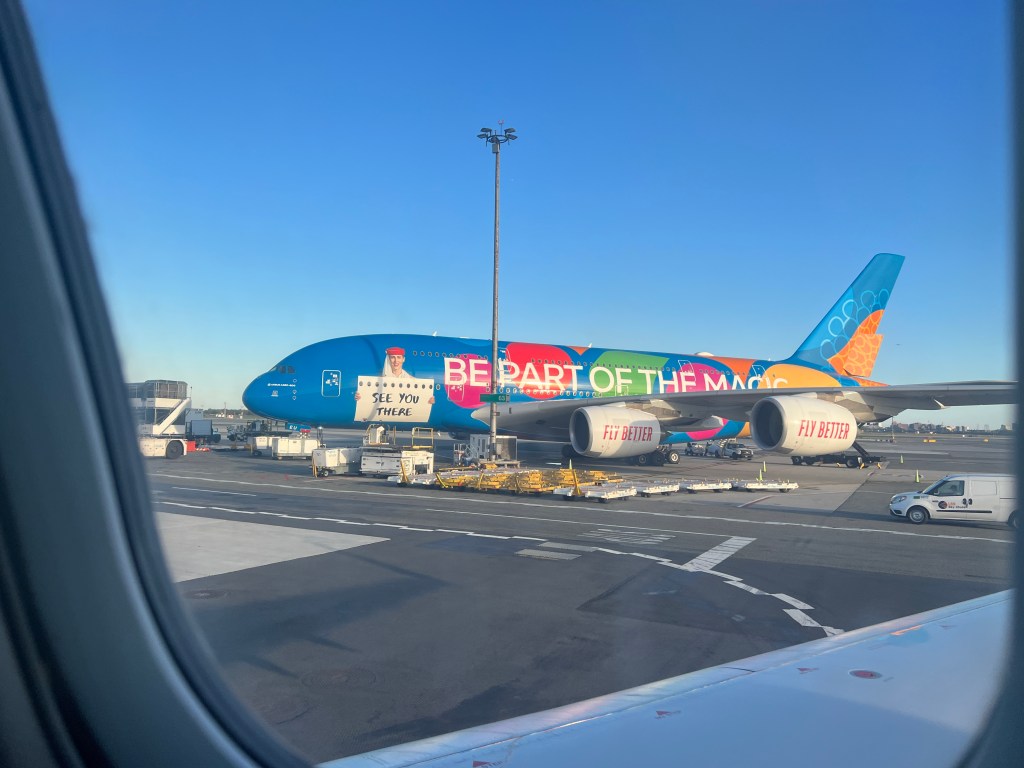
An Emirates A-380 at JFK International. JFK International Airport, New York – Here I was, content on my cramped regional jet because it was taking me where I needed to go. The first three legs of the journey was fine until I got to JFK International Airport.
The jet envy hit me.
You know the feeling, don’t you? One minute you are happy to be at your destination and the next you see a big airliner with an exotic livery and you suddenly wish you were on that plane, going far away.
The last time I was at JFK, last year, I was: I was flying to and from London. This time, not so much.
I have been especially fascinated by the Airbus A-380, the largest passenger jet out there and the only one to have a full-size double deck.
These jets each carry between 575 and 850 (!) passengers super long distances. I haven’t ever been as close to one as I was rolling by in my Canadair 900 regional jet.
It’s not the Boeing 747. But it’s close. -
Wait til next year
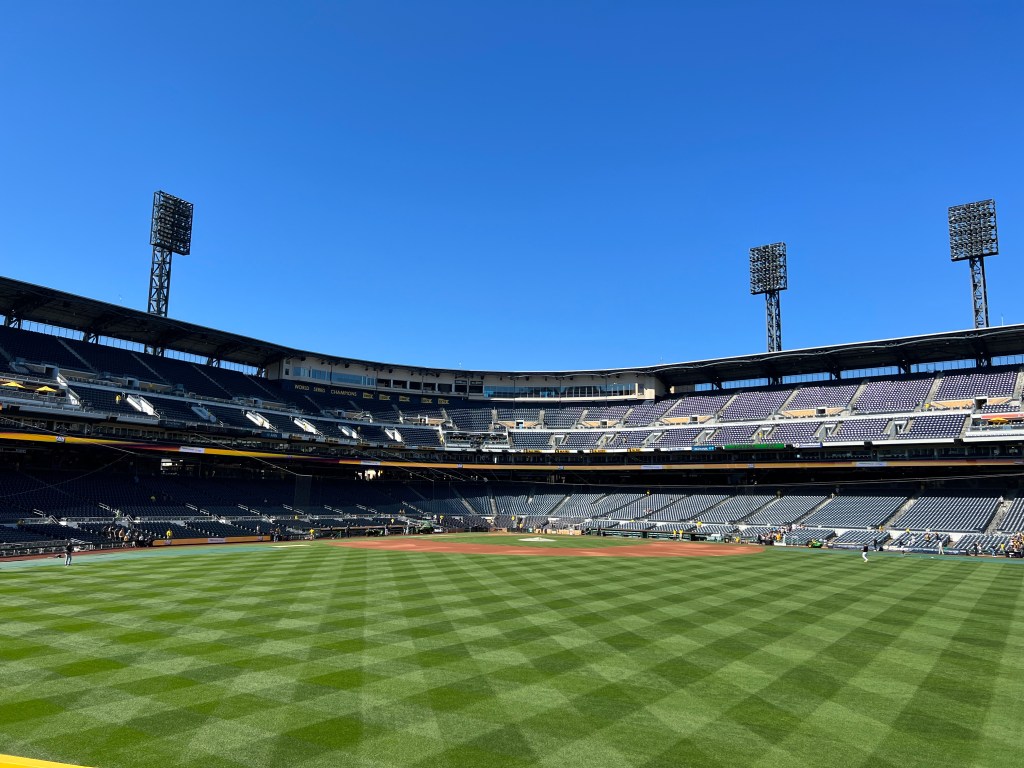
PNC Park. The last game of the regular season, Oct. 1, 2023. A lot warmer than it was on Opening Day in April.
-
Peeps in a new season
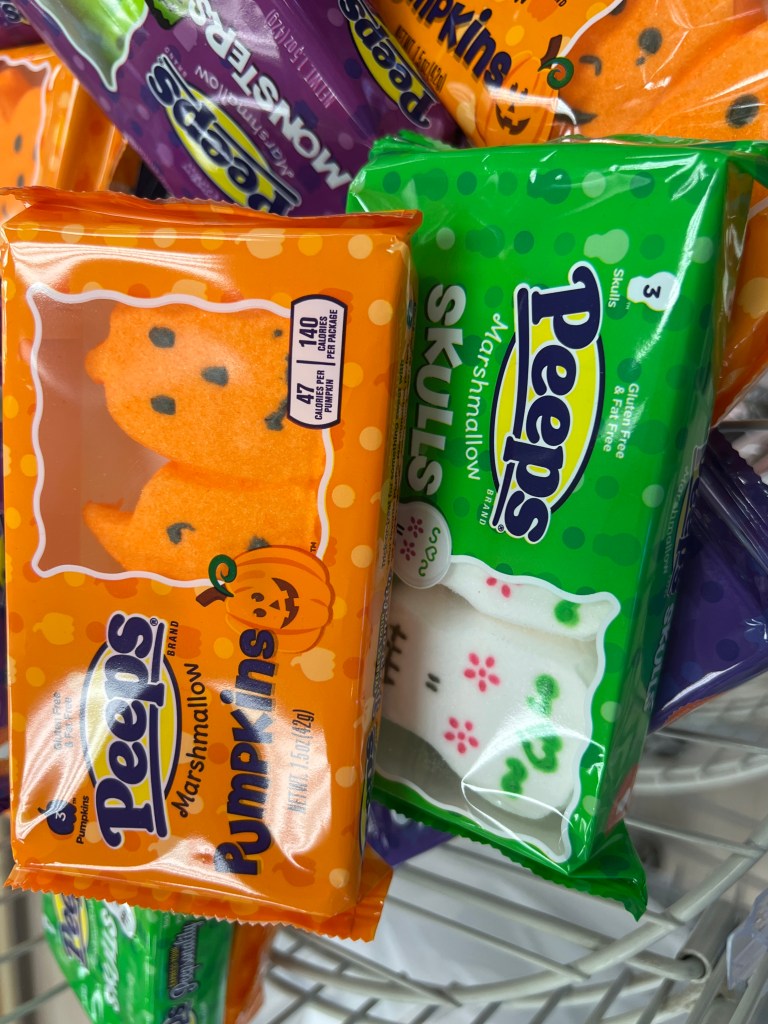
Not a Peeps fan, so I was thrown today when I saw them today. It’s not Easter!
-
RIP, Terry Kirkman
Sad news over the weekend with the passing of Terry Kirkman, cofounder of The Association and the songwriter of “Cherish,” one of the standards of the 1960s and emblematic of The Association’s lush and layered harmonies.
The Association oughtta be in the Rock n Roll Hall of Fame. They’re not, which is a shame. They performed the second-most popular song of the 20th century? “Never My Love.” They didn’t write it but it’s a classic because of them.
The video above, that’s Terry Kirkman and the late Larry Ramos performing the lead vocals LIVE TO TAPE on “The Ed Sullivan Show.” These days most singers lip synch but back in those days The Association was going through the motions on the instruments — which they could play and well — but Kirkman and Ramos are singing those vocals. How can you tell? Because Ramos enunciates one of the lines, and then smiles a bit. Kirkman and Ramos were that good, live or recorded, even though it was one of Ramos’ first songs with the band.
“Never My Love” was the No. 2 song the first full week of my life in what was a terrific month for music just after the Summer of Love: Bobbie Gentry’s “Ode to Billy Joe,” The Box Top’s “The Letter,” The Supremes’ “Reflections,” Jackie Wilson’s “Your Love (Keeps Lifting Me Higher),” and the theme song to one of my favorite movies of the ‘60s, Lulu’s “To Sir With Love.”
And The Association, and Kirkman, was right there with them. They’ll live forever in their recordings.
RIP.
-
Trying to keep a Covid-free streak going
For the past three and a half years, against all odds, I’ve been able to avoid Covid. This week, I’m concerned my luck is about to run out.
I took Covid seriously from the very beginning, ever since I came back from a trip to the United Kingdom in January 2020 and first heard about what was fast becoming SARS-CoV-2. I was one of the lucky ones who were able to work from home for the first two years of the pandemic, and I restricted my social interactions and always with masks. I didn’t even let up when I had the vaccine in the winter of 2021, nor with a booster in April 2022. I wore a mask religiously until September 2022, when I got the bivalent booster and I figured that maybe, just maybe, I could be less careful.
I’ve had close calls. Covid had been in my house in 2022, and while I avoided getting it both times, I’m not sure I could tell you why. But this week we found out that Covid is back in the house. Today I found out it was going through work, too. So there’s a good chance that no matter where I go, I will be coming against Covid again.
First, everyone’s fine. Second, it seems like the majority of Covid cases are mild or at least nothing worse than a moderate case of the flu. No one I know has gone to the hospital or stayed. We’ve tested, we’ve avoided contact, we’ve changed our lives a bit to make sure that the sick child stays home until recovery.
Feels a lot like we’re one of the few families doing that. But I don’t want to be the reason for someone else to get super sick, even if Covid is all around us and there are as many safety precautions. But I digress.
I’m not feeling as anxious this time around as I did. I’ve not only kept up with the Covid vaccines and boosters, but I also got the latest vaccine Friday, four days before I learned of the Covid case at home. I’m hoping the presence of the vaccine will help me out, lessening the chance of a more serious disease. At least that’s the theory. Wish I didn’t have to test it out, but I’m glad the vaccine exists. The vaccine isn’t supposed to prevent disease, just lessen its severity.
Anybody know how long it takes to get fully immunized from this shot? No one does, apparently. Guess I’m going to find out.
And whether my covid-free streak keeps going.
-
A horrific crash close to home
Still reeling from the news of the fatal bus crash on Interstate 84 in Orange County, New York. It’s a spot of highway I know well. I not only used to drive that stretch to and from work in Middletown, New York, but I have been driving that stretch all my life.
One adult killed and dozens of high school kids injured – five critically – when the bus rolled over and fell down the embankment. Thinking of the kids and adults who were on that bus, and their families.
Home
About Me
Journalist and writer. Loves writing, storytelling, books, typewriters. Always trying to find my line. Oh, and here’s where I am now.


Leave a Reply