-
Check mate
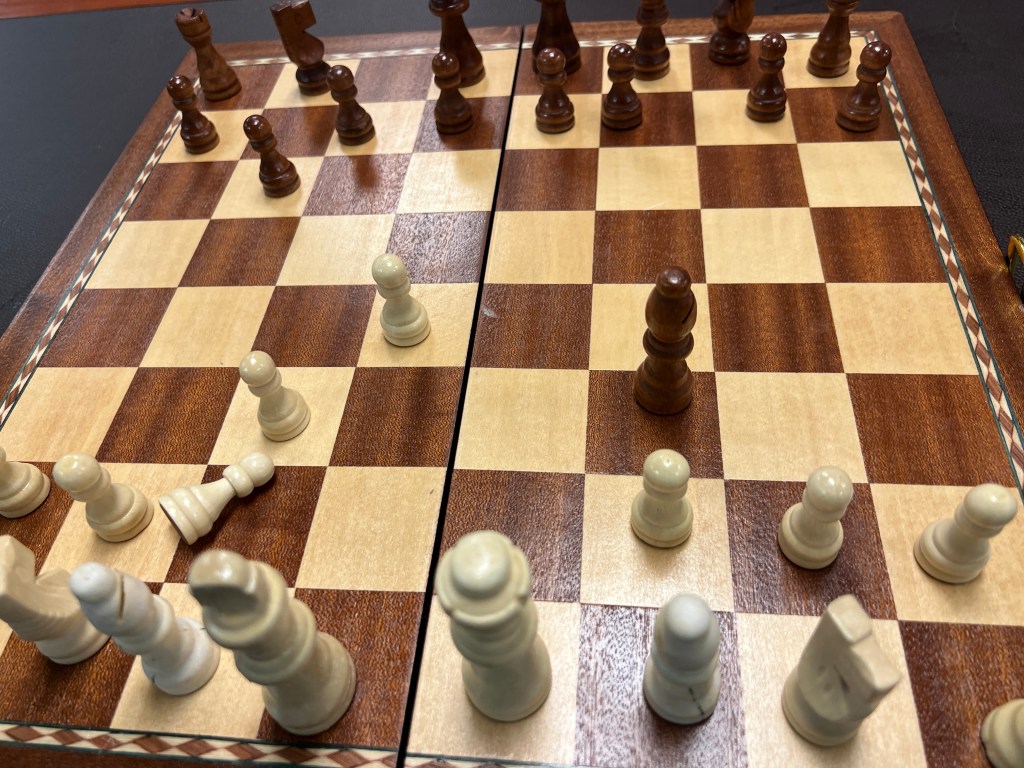
I’ve tried to like chess, I really have. But like just about every other game, I just don’t have it in me.
Intellectually, I do. My father taught me to play chess when I was young, and we played a bit. I played with friends until I was about 12, when I stopped playing altogether. I never picked it up again until one of my daughters decided she wanted to learn to play, and I taught her.
She quickly got bored, so I was off the hook.
I’ve tried to figure out why I don’t like games. I don’t have any on my iPhone or iPad. We have them at home on a shelf, but they haven’t come out since the early days of the pandemic. I don’t remember the last time I played a computer game.
Read somewhere that guys my age love video games, and play them more than watching TV. I also was an early adopter of Dungeons and Dragons, loved playing APBA, Stratomatic and Statis Pro baseball when I was younger. I even played a few leagues. I played a few games in the early ‘90s. Then there was Microsoft Flight Simulator, which I used to enjoy and sunk some money into. One of my flight instructors told me I had been able to transfer the skills behind the screen to the pilot’s seat, so I guess it wasn’t a total waste. But other than that, games haven’t factored into my life.
Reading and writing have been my favored points of relaxation. I even would rather than than most TV or movies.
I thought about this tonight as I sat and watched an impromptu chess tournament. Kids of all ages paired up and played. I was impressed by their concentration, the moves they made on the board, and how they were willing to work together. For all the times kids get yelled at for looking at their smartphones or watch too much TV, it was heartening. -
‘All that’s missing is a sidekick and an all-Welsh crew’
In case you’re like me and you can’t wait for David Tennant and Catherine Tate to return to Doctor Who, here is their finale lo those many years ago as The Doctor and The Fabulous Donna, along with Captain Jack (John Barrowman).
Those are three talented people, right there. The song isn’t familiar to Americans, but you can catch up to that too thanks to YouTube.
I loved the old Doctor Who when I was growing up and it was on PBS, but the reboot is just – as the Ninth Doctor would say – fantastic and I’ve been to a lot of the places they’ve filmed in and around Cardiff, Wales, one of my favorite cities in the world.
-
My acting class experience too
I feel sorry for the “Saturday Night Live” viewers too young to have seen Phil Hartman. Guy never turned in a bad performance.
This is a classic from the mid-1990s that I hadn’t seen, since I was out of college and working and stopped watching “SNL” for a while. It also is familiar, and not always in a funny way, of my own acting classes.
Think I will be saying “This something, this is nothing” for a while.
-
A tool for NaNoWriMo
I’m getting stuck on tools again.
As I get ready for NaNoWriMo, I’m trying to figure out the best way for me to write thousands of words a day, every day in November.
I’m a constant writer, meaning I am almost always putting down into words something, whether it’s for my journalism work that pays the bills, my journal that fills my soul and chronicles my life, or the fiction and nonfiction I write.
For most of my life, I’ve barely cared how I’ve written. I have boxes of notebooks and scraps of paper, hard disks full of Windows and Mac files I’ve written, just about everything you can imagine. I am often undisciplined about how I write a first draft. I’m just always writing.
Not sure that’s going to work this time around for NaNoWriMo.
I took a year off from NaNoWriMo last year. But the most success I’ve had is by writing (and counting), the words via computer or iPhone or iPad app. It also forces me to not only figure out where I am at any one point in November, but I know that what I am doing is not my journal or my journalism, but instead my passion project.
Going to have to figure that one out. -
‘Hold your loves ones closer’
https://obituaries.bangordailynews.com/obituary/darcy-harris-1088903842
There’s a lot to be learned, reading obituaries. Especially when they have some sense of the life of the person who passed.
Here’s one from the Bangor Daily News, commemorating Darcy Lynn Harris, who died Oct. 2, 2023, in Holden. She was 45.
The obituary said she loved writing and saved memorabilia “that best represented her life and adventures.”
And there’s this:The family asks that, if you can, please hold your loved ones closer and to take pictures together even if they refuse. Her memory will live on through her daughters because of the photos and keepsakes Darcy kept with her no matter where life brought her.
RIP, Darcy.
-
Bringing a book to the football game
How can you tell me at a high-school football game? I’m the one with a book.
I’m not a football fan. Never have been. I’ve done a fair amount of football-related stories in my journalism career, whether it’s been going to charity dinners and events where football legends were the guests of honor (Mike Ditka and Joe Namath among them) or covering the NFL media rights deals and TV ratings in the 2000s for The Hollywood Reporter. I think my last NFL story was a deep dive into teams’ Covid protocols in 2021.
I can’t even bring myself to watch a football game. Ever. Before my kid was in cheerleading and then marching band, I went to two football games: One my uncle took me to when he was photographing it for the newspaper (sometime in the mid-1970s) and then one my father took me to at the University of Connecticut on a cold October or November Saturday in 1984.
I remember freezing. I remember being bored. Even when I started at UConn as a freshman two years later, and I lived near the stadium, I could have cared less. I never went.
My lack of interest in football puts me out of step with a lot of America, particularly in Friday Night Lights territory where I live now.
Football is a very big deal. It really wasn’t where I grew up in Connecticut. My high school was too small for a football team. No one ever said they missed it.
Back to tonight, where I am sitting in the cold metal stands, surrounded by fans, mostly parents and grandparents. Maybe I’m the only one who isn’t paying attention. Looks like I’m the only one over the age of 5.
I’m here to support my daughter. She doesn’t care about football either. But she’s in the marching band. So for the last four years, this is what we’ve done.
It’s her senior oyear. I’ll miss the band and the pomp and circumstance. It’s been a big part of her life, and it’s soon to fade away. I don’t want to miss a moment. I’ve enjoyed holding up my iPhone to record each performance, focusing on her.
I won’t miss football. And it took a while for me to figure out that I could do other things in between the marching band performances. Sometimes it was talking to other parents. But lately it’s been reading and writing. Last week, I drafted several pages of writing on my iPhone. Today, with a lot of reading to do for my book project, I brought one of the hardcovers. And I wrote this blog post, and a journal entry. By hand.
I almost brought my Chromebook. I figured that was pushing it.
Right? -
Getting ready for NaNoWriMo
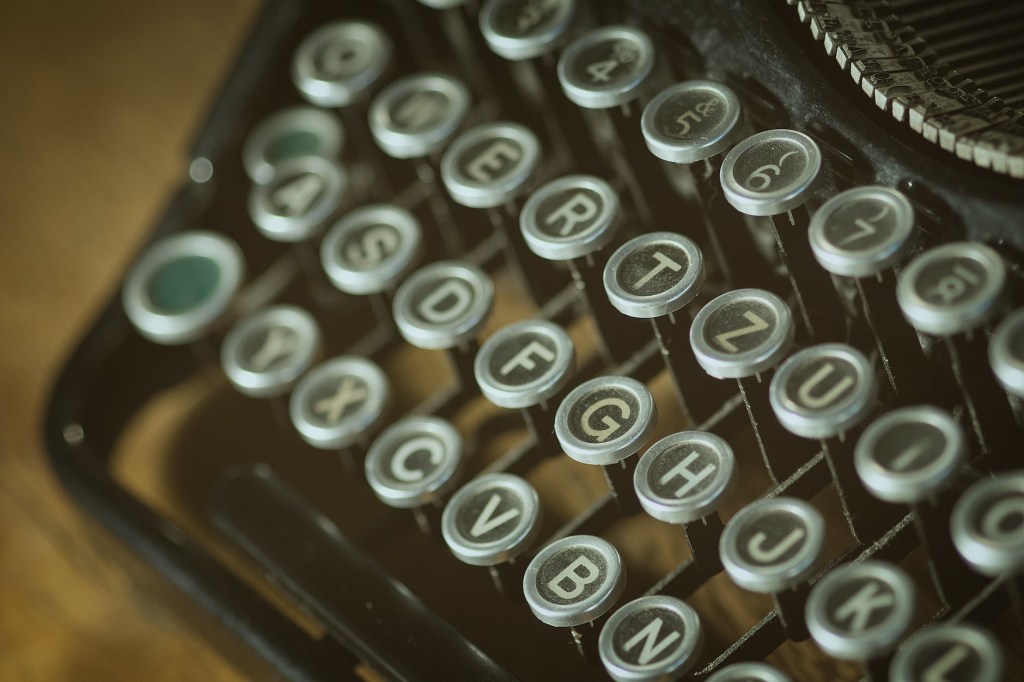
Sixteen days to NaNoWriMo.
This is one of my favorite times of the year, to be honest. I like Thanksgiving just in general as a holiday. I enjoy watching the season tunnel further toward winter, with leaves down and days and nights markedly colder. And I like National Novel Writing Month.
Last year, for the first time in more than a decade, I didn’t participate. I didn’t even try to participate or get ready. I’m a journalist and also an ardent journal writer, so I already spend a lot of time writing. I jump at the chance to be able to stretch myself, and NaNoWriMo since 2009 has been just that for me.
A chance to stretch myself.
But last year was a challenge. I was writing a lot but I was also mired in, frankly, depression and loss. I didn’t feel up to what NaNoWriMo had to offer. It’s taken me a while to get to a place where I could, but I think I am. I’ve written throughout, and some of my most raw and emotional work. But it’s not what I want to share at the moment.
At the beginning of the year, I dropped out of my long-term Welsh studies to focus on a book project that called to me. I’ve been working on the research for the last several months, and I’m getting close to starting a draft. I’ve even fired up Aeon Timeline to get ready.
Writing part of the first draft of this book, it’s a perfect goal for NaNoWriMo.
I can’t wait. -
Sweater weather. Or not.
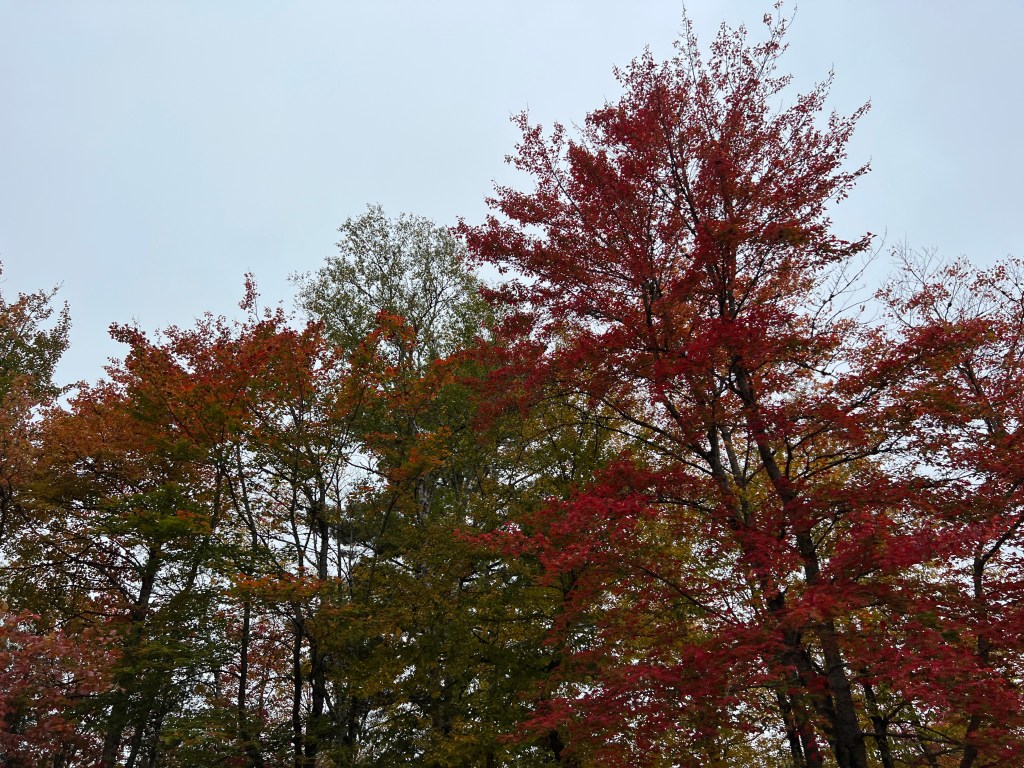
These are the days, in the spring and the fall, where it’s impossible to figure out what to wear.
I had this happen several times this week, when I wore casual clothes – sweater and chinos – to the office. Two other days I had to wear a shirt, tie and jacket, so I wasn’t as bothered.
When I left the house the other days, it was 39 or 40 degrees. That seemed perfect for a sweater. I drove to work and didn’t go outside the whole day. Then I left the office and it was 70-something.
Not sweater weather.
I know it’s a first-world problem. And it’s also something that isn’t destined to last. In another week or two, it’s going to be cold enough for a sweater or jacket all day long.
But it’s hard to play before the weather turns cold. -
To app or not to app
I’ve got a love/hate relationship with apps.
I’m glad I’ve got some of my favorites – Day One and Drafts chief among them — within easy reach, whether it’s on my iPhone, my iPad or MacBook. (Yes, I’ve been Apple-only for at least a decade.) I love to write on Scrivener and Byword. I like being able to watch streaming video services, and even YouTube, wherever I am. And I can scan PDFs and take pictures in archives, which is a lifesaver as I work on my book.
The iPad is also pretty purpose fit for reading, although I still like my Kindle.
But I’ve gone through dozens, maybe hundreds of apps since I got my first iPhone 15 years ago, then added an iMac and iPad more than a decade ago. For a while, it felt like the very app I needed was just within reach. Like Kindle books, most just ended up piling up.
I should say that I don’t have a lot of games. For some reason, and I don’t know why, I don’t have the gene for gaming. It’s not a way I like to spend my time, other than when the kids were young. I might have a half-dozen games, all discarded long ago. The only one I enjoyed really was a retread from the ’90s and early 2000s, “You Don’t Know Jack.” And those aren’t even on iOS anymore. Oh, and Microsoft Flight Simulator.
No, my problem is that I am sometimes obsessed by productivity tools, always eager to try a new writing app (I’m not gonna call it word processing), and whether I was interested in aviation, meteorology, or the Welsh language, well, there’s an app for that. And I’ve been looking into a new wave of apps as I try to store and harness the thousands upon thousands of articles, notes and PDFs for this book project. That’s another story.
But I don’t use most of them, or long since ditched them. While I’d like to have that money back, it is what it is. But I hate moving back and forth between iPhone screens, even with folders. So I committed myself to cutting back on apps, moving them out when they’re done (like a hotel or airline app after the trip). So I only keep two pages on the iPhone, with separate folders for Productivity and Entertainment.
I prune the apps regularly. I have even fewer on the iPad.
It’s a little more difficult on the Mac. I’ve never found an elegant solution for the apps other than the list, which stretches to two pages on its own. I move those in and out, too. And since I started working with Obsidian and upgraded Aeon Timeline, I’ve added one or two.
I’m resigned to adding a few right now. But I’m not sure. -
On the thin margin
Life can be a matter of inches.
The difference between a grand slam and a foul ball. Whether your eyes meet with the love of your life, or she passes by, a face in the crowd. Or the narrow space between a high-speed crash or driving off unscathed.
We walk around knowing that, often saying “there by the grace of God go I.” Living to an old age is miraculous, given that for most of human history the Earth and life itself was inhospitable. The Covid-19 pandemic taught us that again, when a tiny virus meant a matter of life and death for untold millions across the globe.
Life taught me that lesson yesterday morning, when I was on the far end of a vicious multicar crash on the interstate highway on my way to work. I was within an inch or two of being struck by a vehicle tumbling out of control, a cacophony of metal and dust that breezed by my rear-view mirror between my car and the SUV behind you.
It happened so suddenly, it was hard to register what was happening. Until I glanced over at the grassy median and saw an SUV on its side.
What I didn’t know was the whole picture. I pulled over into the right lane and then over to the side of the highway. I called 911, told them to come quick. I described the car on its side, a few other cars behind me. I said I think I knew what happened, at least in the beginning, and would stay for the state cop to arrive.
Then I headed out of my car and across the highway, where the cars and trucks slowed but didn’t stop. The woman behind me had stopped, essentially where the crash happened. Her car was clipped in the back by another car that didn’t stop. A sedan sat in the breakdown lane, with front-end damage. The 20-something guy behind the wheel was shaken up but unhurt; the woman behind me wasn’t hurt either. She was amazing, helping to get the couple in the tumbled SUV out of their car and then tending to their minor wounds. Turns out she went to high school with the driver and his wife.
We were both just glad the couple whose car had smashed into the median weren’t hurt badly. When I called 911 I feared the worst. It’s nice to see when the worst doesn’t happen.
We each knew a piece of what happened.
In the front of the line, I had a few moments before the accident saw a black sedan screaching past me in the righthand lane, perhaps trying to get out of the traffic conga line. The car suddenly changed lanes, about three cars in front of me, and abruptly slid into a cars-length space. The cars behind, already going a little bit over the speed limit in the travel lane, tapped and then more urgently hit the brakes. I had some room behind me so I didn’t stop so abruptly until the second set of brake lights.
What a jerk, I thought. It didn’t seem necessary to swing from the right to the left lane, moving so fast.
I had just slowed and put my foot on the accelerator when a gray SUV tumbled through my back mirrors and landed in a pile of dust I could see, even thought it wasn’t sunrise yet.
It was inches from hitting me, that I knew. I didn’t know the rest but I knew I needed to call it in, needed to stay. Turns out that it was only the four of us. The car that cut in front probably wasn’t aware of the crash. The cars in front of me and around me, other than the woman in the SUV directly behind me, drove off. It turned out to be just her and me, the couple in the car that left the roadway, and then the other driver and a truck driver.
Felt like forever before EMS, then the state cops came. Turns out I wasn’t necessarily needed, for the truck driver — who, like me, had stopped because we were concerned — had dashboard video of the whole thing. I told the trooper my view of what happened, as he requested.
It could have been much worse.
As I walked back to the car — waiting to cross the highway, where the cars were moving about 20 mph in both directions — I started to ponder what it all meant. How close had I come to disaster? Less than a second, it seemed. I happened to be in the right place at the right time: away. A second earlier and I would have been safely past this crash. A second later and I would have been hit by the tumbling car broadside. I have a small car. It might have been me in the ditch.
I had forgotten, after working from home for more than two years, how dangerous it is to drive sometimes. We focus on the days and nights of snow and ice, when most everyone is on the alert. But this day was dawning bright and cool and clear, not the typical day for a crash.
Except I knew, from my days as a volunteer firefighter and then as a young adult covering cops, that the worst crashes could happen in the most beautiful weather. One crash, 30 years ago, killed a teen-ager and a retiree, both traveling in opposite directions of I-95 but meeting tragically in a multicar crash. It was a 75-degree, clear-as-a-bell afternoon just before the Strawberry Hill Avenue exit in Norwalk, Connecticut.
The teenagers’ car, with four kids in it, had been traveling so fast that it left the northbound lanes of I-95 and bounced into the southbound lanes, where cars and trucks were moving just as fast as they were on the other side. As I recall, the teens’ sedan was hit by one car before being smashed squarely by a Buick with four retired people.
One teenager died at the scene, and I’ll never forget that. One of the retirees later died at the hospital. Things were never the same again for the other six people in those two cars.
It was a matter of inches, a matter of life and death.
Yesterday though, it went the other way. I saw part of a violent crash, all in my rear-view mirror. No one died or was severely hurt.
But it was only a matter of inches.
Home
About Me
Journalist and writer. Loves writing, storytelling, books, typewriters. Always trying to find my line. Oh, and here’s where I am now.
 Nows and Forevers
Leave a comment