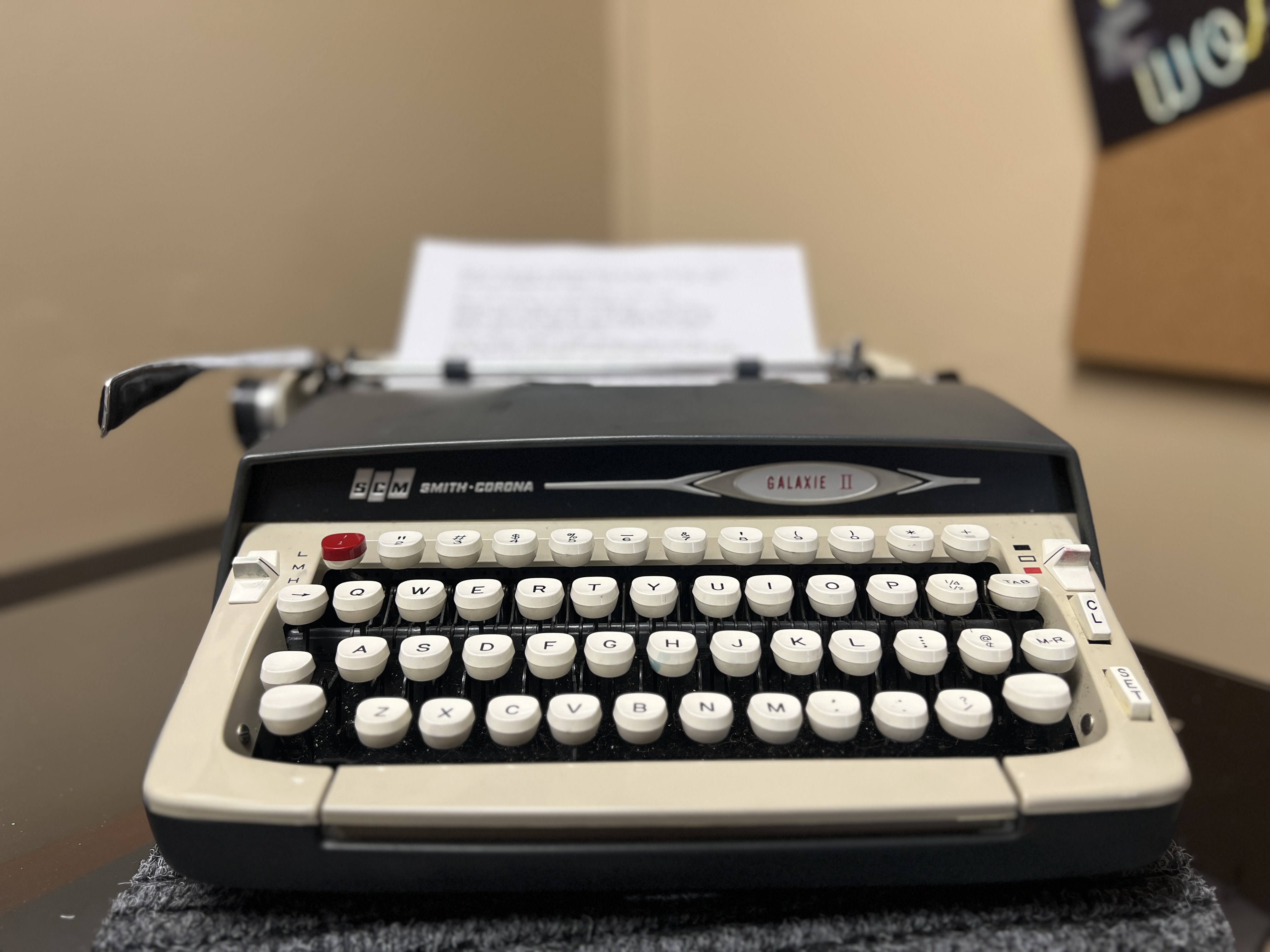
-
Show, don’t tell

Word of advice that I put on my new Chromebook, which has been serving as my main writing device the past several weeks:
Show, don’t tell.
I found this sticker online and I wanted to find a spot on the Chromebook so that I see those three words every time I sit down to write.
Powerful words, they are.
Sometimes, all you can do is tell. But if you want to really impact readers, have them really see it, you have to show.
I need to do more showing, less telling.
And, related: Less talking, more writing.
Those are two goals through the rest of ’23.
-
Pushing a noun against a verb
One of the great scenes in “Inherit the Wind.” “You never pushed a noun against a verb except to blow up something.”
“Inherit the Wind” is one of the great plays of the ’50s and one of the great movies of 1960. It’s kind of stunning that it didn’t win anything at the Academy Awards. Putatively about the 1920s Scopes Monkey Trial, it’s also about McCarthyism and the 1950s, and 63 years after its release, it has a lot to say about the world we live in today.
The script and the play not only are first rate-dramas, but they offer so much in the writing. And the movie has first-rate acting: Spencer Tracy, Frederic March, Gene Kelly (yes, that Gene Kelly), Dick York, Harry Morgan. Tracy and March are at the top of their game, in roles of a lifetime of it wasn’t for the fact that they always brought the heat. Tracey plays the character named after Clarence Darrow, who has always been a personal hero of mine. (Here’s why.) York, who became well known on “Bewitched,” is outstanding as the teacher accused of teaching evolution in violation of state law.
I am blown away, though, by Kelly’a performance. He was already in some of the great movies of the late ’40s and ’50s including the groundbreaking “Singin’ in the Rain.” Kelly was what they call in Hollywood a multihyphenate – dancer, singer, choreographer, director and musical actor – but not known for drama.
Until this movie.
He was fabulous as E.K. Hornbeck, modeled after journalist H.L. Mencken. It’s this scene, sparring at the very end with Tracy, that Kelly shows he can go toe-to-toe with the best.
So good.
As a journalist, it’s also an object lesson, a reminder that your humanity is important in your search for truth. There’s such thing as being too cynical, to in Tracy’s words needlessly push a noun against a verb.
I don’t like to watch courtroom dramas as a rule, maybe because I have spent a fair amount of time covering the justice system. But “Inherit the Wind,” as well as “The Caine Mutiny Court-Martial,” are exceptions to the rule. So is another classic, “Twelve Angry Men.”
All three from the ’50s, which if you look back is a lot less rosy and idyllic than collective memory suggests. And if you haven’t seen either “Inherit the Wind” and “Twelve Angry Men,” you should. They are the kind of movies not made anymore but should.
-
Flag Day, a birthday
Yesterday wasn’t just Flag Day. Wednesday was what would have been the 83rd birthday of my eighth-grade English teacher, Kathy Clark.
Amazing what you remember, isn’t it?
Been a long time since I was an 8th grader at Coronado Middle School in Coronado, California. I was a transfer student from Connecticut, just me and my mom at first and a continent away from my father, grandparents and everything I’d ever known. I hadn’t ever been this far west, even for a visit.
Mrs. Clark was the first teacher I had who I considered more than just a teacher. All through elementary and middle school I liked my teachers but rarely if ever thought of them as having lives outside of school, even if I saw them in the community. But Mrs. Clark was different. She was a great teacher and communicated her passion for English to her students. But she also communicated her zest and passion for life, and all the wonderful opportunities it presented.
She, like many of us at Coronado schools, had grown up as the child of a Navy parent. She came to Coronado as a young girl in the early 1950s, left for a while because of the Navy, and returned for her senior year to graduate from Coronado High School in 1958. She was Miss Coronado that year, something she talked about with a smile. She shared other experiences in her life, which by the time I was in her class was about 40 years, a little less than half her time on earth. And I remember one day other teachers celebrating her birthday.
Flag Day.
Don’t know why I remember still. But I do.
I also remember a lot of the skills Mrs. Clark taught me that year, including a dose of grammar that was intense but also delivered in such a way that it stuck, and a love of the theatre, which she had and I did, too. I remember one of her projects, writing a letter to a company about an issue and getting a response. It taught us how to compose a business letter and to advocate for ourselves. I picked a life insurance company and asked for more information about its commitment to seat-belt innovation and safety. And they responded!
I left Mrs. Clark’s class with a love of English and the inspiration to read and write, even more than I did before. It would set me along the path of English and literature and writing classes throughout high school and college, to the point where I came this close to majoring in English (I took almost enough classes to do so) and helped prepare me for the career I have. And it was in my eighth grade year that I began in earnest writing stories, thanks to her inspiration and the fact that I realized I finally had something to say.
I left Coronado in the middle of 10th grade, headed back to the East Coast when my mother was diagnosed with cancer. I lost track of all of my friends in Coronado in the next several years and it is the only part of my life that Facebook hasn’t re-connected. I had thought about going to college in San Diego but decided against it, and it wasn’t until 22 years later, when I worked for The Hollywood Reporter, that I ever got back to California. I was there twice since then, seeing the old places but not attempting to make any connections with anyone I used to know.
So it wasn’t until recently that I learned that Mrs. Clark died in 2015 after a bout with cancer. It’s hard, sometimes, to reconcile the younger person you used to know with a man or a woman claimed by cancer. I’ve felt that way with a number of friends and family members, including my mother, who died young. Mrs. Clark was the bright, full-of spirt 42-year-old woman who taught me so long ago. Time passes, whether we realize it or not.
Yet reading her obituary in The Coronado Times and a tribute from another teacher, I learned what I already knew: Thousands of Coronado Middle School students before and after me were also affected by her.
The obituary had a quote from Mrs. Clark, days before she died:
“I just hope and pray one student would have found some inspiration in what I taught,” she said. “That would make me happy.”
Mrs. Clark, you did. Thank you.
-
The vanishing Internet prose

How can I make my words on the Internet last? Is that even possible?
I didn’t used to worry about this. For most of my journalism career, I rarely thought about the future of the newspaper stories I wrote. I worried about getting the story first, right and well-written. The next week, month or years into the future weren’t mine to consider. Print-era newspaper editors and reporters tend to think of today’s edition to be tomorrow’s bird-cage liner or recycling. It’s just the way it is.
Maybe once in a while I thought about what an historian might think of a story I wrote, uncovering it the next-generation archive, just as I wonder sometimes about my journalistic predecessors when I look at stories in old newspapers. But that was it, other than clipping most (but not all) of my stories.
Along the way, the daily newspaper mentality heightened to hourly, and then to moment-by-moment as the web and then social media came along. The pace of the news quickened, and with it, the ephemeral nature of scoops and stories. I didn’t have any expectation that stories of mine in the print-only era would be preserved, outside of a few microfiche rolls. But the web, ever-growing, would be different. Those stories, they would always be there.
Except they weren’t.
The dozen or so years of stories of my current employer remain online, and always will. They have a strong and good archive system. So are the archives of a former employer, Mediapost, where I was senior editor for three years in the early 2000s. A few of my newspaper stories remain online at the suburban New York daily newspaper I worked at in 2001 and 2002, the oldest of my stories to remain online.
But a large part of the work I’m most proud of, when I was a TV and media reporter at The Hollywood Reporter, has been wiped from the archives. Also missing are the stories in some of the syndicated partners, Reuters and Yahoo, where our stories were republished. Most of my stories from late 2006 to 2010 appear to be on the THR.com archives, although with the byline of “Associated Press” instead of The Hollywood Reporter. (That irks me, since I was on staff. Looks like a computer glitch.)
But all the work I did, several stories a day, between 2004 and mid-2006, they’re gone.
I’m not bringing this up because I care about my deathless prose. I’m proud of my work, but a lot of its value — most of its value — came in the hours and days after the stories were published. But I also believe in a record, expanding as it does every day, of what has happened in this world and why. How many other publications and writers’ work have been wiped away, either through a change in websites (like I think happened with THR.com) or when the outlets themselves closed? One magazine I worked for no longer exists, and all that work is gone.
I have copies of my Hollywood Reporter stories, so I’m not missing anything. But the cover stories I wrote for about eight monthly magazines, they’re gone and won’t ever come back. I don’t have physical copies of any but one. I guess I always thought they’d be there.
It makes me worry about the future. Whole publications, and work of writers and journalists and bloggers, have disappeared. And they won’t ever come back, and I am full of sorrow. Some of those writers, including people I know and love, have passed from this world. I wish their legacy, the voices they left behind, weren’t stilled too.
The past few years, I’ve tried to protect my own work, at least as much as I can. I long ago lost my published articles from the late ’80s into 2000, never making one of my many moves. I’ve been able to reconstruct some of them, thanks to visiting the library in Norwalk, Connecticut, where there’s microfilm of The Hour where I worked for a lot of that period. I’ve also been able to find about a year and a half’s work at other newspapers. But there’s a lot that I have no physical or digital copies of, and it’s probably not going to happen. One newspaper I worked, since closed, apparently has no archive anywhere. Another is collected in only one place I’ll probably never get to.
And my work at my first newspaper, in Connecticut near the New York border, is available on microfilm at a library or two. But how much time do I have to go through three or four years’ worth of daily newspapers?
I don’t.
What I do, from time to time, is work to collect what I can and save it digitally. Authory is a website that I pay for gladly, an archive of currently published material that can go back into online archives to extract and save journalists’ stories and even blogs and social media posts. I’ve done that for as much as I can, knowing that the first decade and a half of my career, that’s not possible. I’ve also been scanning articles here and there that are only available offline, and then putting them into Authory. It’s a massive job if you’re prolific, and one that I don’t have a ton of time to work on.
Authory is oh-so-worth it, in my opinion. It also creates a digital offline archive if wanted. I’m thankful that there’s such an option as Authory, and I’ve been pleased with the fast and perfect customer support.
It’s the only tool I have to try to preserve the past.
-
A paper problem
In the digital age, print still matters. Or at least it’s still causing challenges for some.
Yesterday, a U.K. Parliament report on former Prime Minister Boris Johnson ended up being delayed a day because of printing issues. No idea what they were, but we all have had those from time to time, right?
I have been in the news business a long time, and for the first 20 or so years of my career, I spent most of my time working alongside a team of journalists and printers who every day published a newspaper. It didn’t matter what happened, either in the world or locally, there was a paper the next day.
War in the Persian Gulf? Newspaper came out the next day. A blizzard? Ink still hit paper and went out the door, even if we had a skeleton staff and roads too snowed in to deliver to everyone. Power failures on deadline? It might delay a for a bit but we had contingency plans to make sure the papers went out.
The biggest story of my career, the terrorist attacks on Sept. 11, 2001, shook all of us New Yorkers (and everyone else) to our core. But we sprung into action, and not only did the presses roll the next morning but also a special edition that afternoon. (I can’t remember that happening before that, and credit to my bosses for that brilliant and old-school move.)
All this to say that stuff happens, and we get over it. My reporting career is a daily exercise in hurdles and challenges, and it’s part of the business. This U.K. delay was just a bump in the road on the way to the latest “Partygate” developments.
But it shows the importance of print.
-
‘Strange New Worlds’ for a new season
“Star Trek: Strange New Worlds.” One of the few constants in my life has been “Star Trek.” I was born during the original run of the series in the 1960s, was a member of the first generation to catch it in reruns in the early 1970s and I’ve been a fan ever since. With the exception of “Enterprise” (and “Prodigy” in the latest generation of series), I’ve been a huge fan.
I had been hooked by the idea of a series starring Captain Christopher Pike, the hero of the original 1964 pilot, after seeing Pike, a young Spock and Number One in the second season of “Star Trek Discovery.” One of the few positive news items of the pandemic was the fact that Paramount Pictures agreed, and a year ago, in May 2022, the first 10-run episodes of “Star Trek: Strange New Worlds” aired on Paramount Plus.
“Strange New Worlds” was pretty good, especially the first and last episode of the first season. Sure, it was a departure from the serialized “Discovery” and, to a lesser extent, “Star Trek: Deep Space Nine,” which remains my favorite of all the series except for TOS. They were individualized, one-off episodes that introduced new characters along with old, and started to fill out the mythology of the Pike era of the USS Enterprise. Anson Mount, Ethan Peck and Rebecca Romijn, along with the other actors and actresses, bring a lot to the characters.
Now they’re back for a second season, and I’m looking forward to every minute.
-
Drawing inspiration from August Wilson, and premiere of ‘The Piano Lesson’
I’m a long way from Broadway these days, but I know well one of the nominees for Best Revival of a Play: “The Piano Lesson.”
As a college sophomore, I was in the audience of the premiere on Nov. 23, 1987, at the Yale Repertory Theatre in New Haven, Connecticut. It was completely by accident, and a fortunate one.
My music-history professor had two tickets that she couldn’t use, and asked my class if anyone wanted them. They were for August Wilson’s newest play.
She had me at August Wilson.
I knew August Wilson because a few years before, while at Wesleyan University’s Center for Creative Youth writing program, I had seen one of Wilson’s plays being workshopped during a field trip to the Eugene O’Neill Theater Center in Waterford, Connecticut. Back then, I wanted to be a playwright and I had spent just about all of my youth on the stage. Connecticut, so well placed next to New York City, was a good place to grow up and dream of the stage.
And August Wilson was one of the playwrights that I knew. And even though I had only been to the Pittsburgh airport, even as a teen-ager I had gotten a glimpse of Wilson’s genius and sweep and the strong sense of place of the Hill District.
“The Piano Lesson” was the next in the Pittsburgh Cycle, taking place in 1936. It starred an actor named Samuel L. Jackson, long before he was ever in “Pulp Fiction” or any Marvel movies. But we didn’t know what the future held for him.
I didn’t have a girlfriend at that moment, so I asked one of my college friends, Peter, if he wanted to go. He wasn’t a literary type and he knew nothing about the stage and even less about Pittsburgh. We sat in the back, among the few students who were at the premiere. I didn’t know much about New Haven and Yale high society, but I could tell that many of those people were in the theatre with us. We wore ties and jackets, but we were without a doubt underclassmen out of place.
I remember being taken to a world I didn’t know, like the best theatre. I remember the acting and the strength of the writing. And I remember Lloyd Richards, the Yale Rep director, gushing about Wilson and “The Piano Lesson.” He was right: “The Piano Lesson” would hit Broadway a few years later, nominated for many Tony Awards and winning not only the Drama Desk Award for Outstanding Play but the 1990 Pulitzer Prize for Drama.
But the most enduring memory of that night came after the play was over. Peter and I were among the first people out, into a cool Connecticut night. On the way out, on the sidewalk on Chapel Street in front of the theatre, I spied a bearded man in a tweed cap, smoking.
August Wilson.
I knew him, for only a month or two before I had read a quote from him in Esquire that immediately became my mantra. He looked just like his photo, down to the cap.
“That’s August Wilson,” I told Peter. “The playwright.”
It was clear that I was one of the few people who noticed. The crowd streamed past him, into the night, crossing the street to the Yale campus or turning right or left onto Chapel Street. Wilson kept puffing and no doubt thinking of “The Piano Lesson.”
“Let’s go over,” I told Peter. He tagged along.
Meeting new people, no matter what they do, has never been something that bothered me. I guess I’m an introvert at heart, but I have never had too many jitters in meeting new people. I learned that from my mother and my maternal grandfather, I think, along with my father. That’s the way they were. Good thing I became a journalist, where I’ve been able to use this to good effect.
But then, I was 20 years old and I was walking up to the first playwright I had ever met.
“Mr. Wilson,” I said. “It was fantastic.”
Wilson looked at us, thanked us. I don’t think that the opinion of two sophomores mattered in the grand scheme of things. But he was gracious and appreciative. I told him that I appreciated also what he said in Esquire, that those lines meant a lot to me.
He thanked me, shook my hand, and then we moved on. A couple had realized who we were talking to, and introduced themselves.
We walked down Chapel Street.
Peter was pumped.
“I can’t believe we met the author,” he said.
I couldn’t either. Of all the famous people I’ve met, both as a civilian and as a journalist — including several presidents and any number of Hollywood stars — August Wilson remains in a class by himself. It’s been nearly 40 years, but I’ll never forget.
Nor will I forget Wilson’s words, which I thanked him for.
I clipped the words out of Esquire, and wrote them in my journal and also on a makeshift sign at my desk:
Confront the dark parts of yourself, and work to banish them with illumination and forgiveness. Your willingness to wrestle with your demons will cause your angels to sing. Use the pain as fuel, as a reminder of your strength.
August WilsonLooking back, there are few lines that have affected me more, or distilled my life’s mission, than this. Because not only do I write for a living, I write to live. Even though many of those words are only for me. Wilson’s words in Esquire helped me in the aftermath of one of the darkest periods of my life, which had occurred the year before. They have helped me in the dark times since, even if I unevenly applied the advice to the detriment of my loved ones. Wrestling with my demons didn’t always cause my angels to sing.
I wish they had. Do I wish they had.
-
The sabbatical that wasn’t, 3 years ago
I think about how different the world is today than it was three years ago, when we were still in lockdown in the state where I live, and having to come to terms with the fear of Covid-19 and the sudden and deep isolation.
One of the things that I heard from people, online and also in real life, was that they were taking it as a sabbatical. Lots of people, according to this Vox article, were taking that time to grow as people. Good for them. But it wasn’t my reality.
I have to say that the lockdown and the time that I’ve been working from home since this all started has been anything but a time of leisure: For the first several months I worked almost nonstop covering the pandemic for my journalism job and the rest of it was spent worrying about my family and the state of the world. And I didn’t have it even a fraction as bad as many of the other people working in the industries that I cover, health care and energy among them. They had to work, at great peril.
There wasn’t a lockdown for them.
I didn’t have time to write a novel, bake sourdough bread, or what have you. I was able to keep something of a journal of the lockdown time, though not as much as I would have wanted given time constraints. But I would have chronicled that time in my journal anyway, as I have pretty steadily since 1990 or so. I just didn’t have a lot of extra time on my hands.
And even if I did, I don’t think “King Lear” would have come out of my MacBook. I’m proud of the people who were able to turn this whole experience around. But, like the writer of this Vox article two years ago, I think surviving it in one piece is worth a lot, too.
There is one big difference between me now and me then, other than full vaccination status: I joined the many who learned a language. But I can’t even say that was because of Covid. I left Wales in January 2020 determined to learn Welsh, just as I did after being a kid leaving Montreal and being annoyed that I couldn’t understand what was going on around me. (Mission accomplished, even if I’ve forgotten most of it.) But lockdown and Covid actually got in the way. But by the end of 2020, with things settling into a heightened set of normalcy despite the pandemic, I was able to begin.
But it didn’t happen in those early months of the pandemic.
-
Smoking still makes me burn

I’ve always had a serious dislike of smoking.
It’s not just that it causes cancer, is an expensive and otherwise unhealthy habit, and makes the air unclean for all the nonsmokers like me who are nearby. I hate the smell of smoke on other people, and one time long ago I remember turning away from otherwise attractive woman who liked me because she was a smoker.
Part of it, of course, is the fact that I have asthma and literally can’t be around smoke. But it’s also about how revolting smoking is to me.
I can honestly say I’ve drawn two cigarettes in my entire life, when they were offered to me, as a teenager. And I couldn’t take more than one puff each before handing it back.
Luckily, I’ve rarely been around smokers in my family. My mother and father smoked in the ‘60s when they were young. My mother stopped cold turkey in her first year of college, when she dropped embers into a wastebasket and it caught fire. My father stopped before I was born, although he took it up again briefly when he was dating a smoker and just as quickly gave it up. I think there was something about the withering glare I gave him as a teenager when he tried to explain why he had taken up the habit again.
My stepfather also smoked but quit, instantly, when he found out my mom was pregnant with my sister. That was 40 years ago and he hasn’t faltered.
My grandmother also smoked, but quit when I was a baby. She became the biggest anti-smoking advocate I’ve ever seen. She told me once that there’s no bigger enemy of smoking than an ex-smoker who quit. I was telling that to someone the other day who agreed, because she also had quit decades ago.
Ironically, my grandmother quit smoking 45 years before she was diagnosed with lung cancer. We never did get to the bottom of it, but I’ve worried when I see smokers that they could be risking lung cancer even if they quit long ago.
I don’t know too many smokers now. One of my colleagues, an avid smoker, passed away during the pandemic. I know some neighbors who smoke, because I see their cigarette butts on the street. That’s another thing that I can’t stand about smoking: The cigarette butts. I was walking into a restaurant the other day and I saw about a dozen cigarette butts outside in front of the place. It was not only littering but incredibly unappetizing.
It’s a lot different of a world than when I grew up. In some ways that’s bad, but in other ways, it’s good. Smoking used to be everywhere, and my lungs would be inflamed because of it. I couldn’t go to restaurants, stores or on airplanes without becoming miserable. That’s all gone away now and we can enjoy these places smoke free. It’s a blessing for everyone’s health.
But the butts, well, they sometimes remain.
-
An ebbing of remote work?
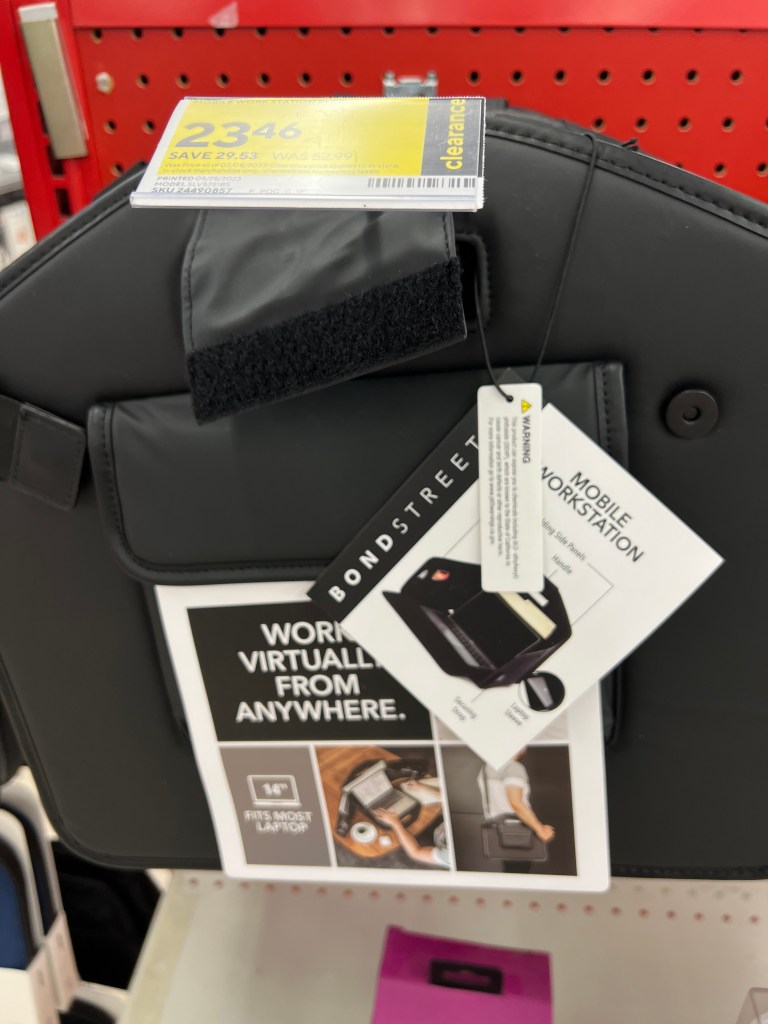
Here’s another data point that says to me that the work-from-anywhere revolution may be dimming.
The past few weeks I’ve seen a lot more devices and accessories aimed at the remote worker on clearance at my local Staples. It’s reminiscent of 2021, when I started seeing previously difficult-to-find items like masks and hand sanitizer going on clearance.
Coincidence?
Like this mobile work station, which is on sale for half off. It’s sort of a combination laptop bag, file folder and portable desk. And it’s got a way to carry it all.
I’m a sucker for the latest office tech, and spend a fair amount of my time working from outside the office, home or workplace, long before it became a necessity in March 2020. But it didn’t take more than a few minutes for me to realize that this mobile work station wasn’t for me.
I’m happy to stick with my laptop bag and, when I need a lap desk, I just use that.
Home
About Me
Journalist and writer. Loves writing, storytelling, books, typewriters. Always trying to find my line. Oh, and here’s where I am now.


Leave a Reply