-
Smoke, wildfires now and a quarter-century ago
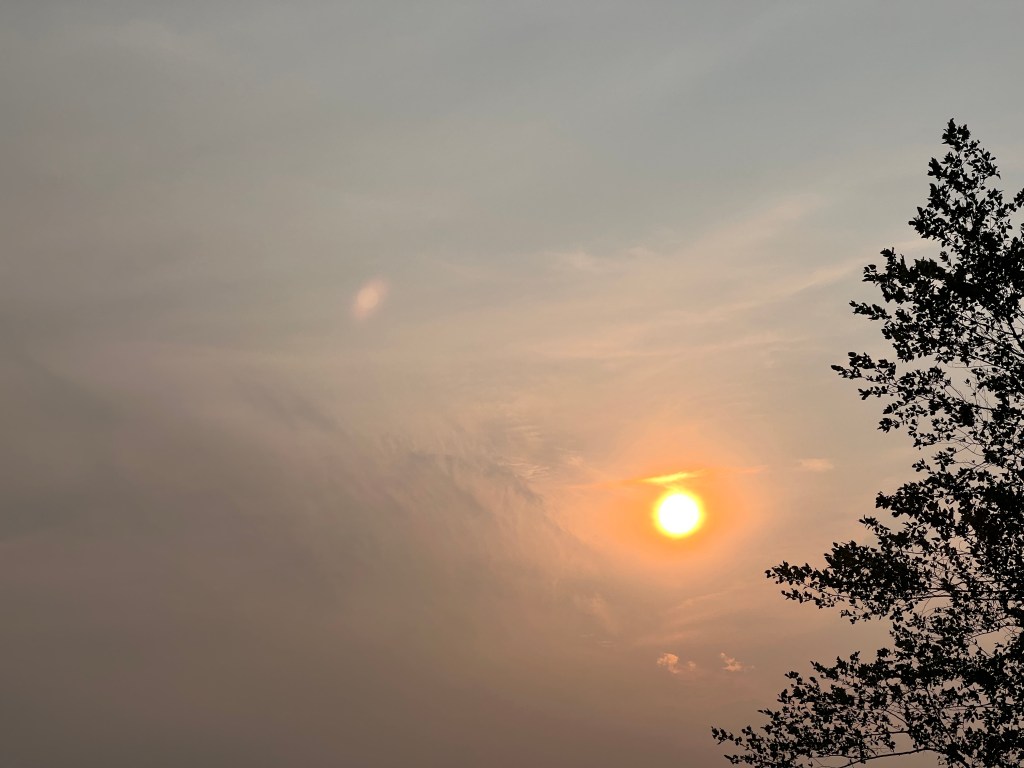
The otherworldly smoke and health threats this week from plumes from Canadian wildfires — and the unreal photos from New York City and Hudson Valley, among other places — make it difficult for me to reconcile the places I used to live with the Mars-like skies of now.
I can’t imagine what it must be like to have asthma, COPD or another health condition and trying to just get by this week.
Where I live now has a lot of industrial pollution and all-too-frequent health alerts due to temperature inversions that trap pollutants near the surface. But even with all of that, I could tell that we, too, were affected by the smoke plumes. I could see the abnormal haze and the diffracted sunlight as I walked in a local park. I also monitor my workouts with health apps, and I could tell something was dragging my performance ever-so-slightly. The wheezing and sore throat I felt from spring allergies were worse by the time I ended the workout about 15 minutes earlier than I planned.
And that’s just here, where things aren’t anywhere as impacted as New York and the rest of the Eastern Seaboard.
It recalled my time living in northern Maine, where the winds blew smoke and sometimes ash from wildfires in Quebec back across the border.
One of those times was exactly 25 years ago this week, on June 10, 1997, when I was living in Maine. I’ll never forget the smoky smell that permeated everything, the gradual reduction in the sun, and especially the occasional ash that drifted and fell from the sky like a light snow.
It was like standing too close to a bonfire but without the intense heat, I wrote in my journal.
I was new to living in Maine then. I had moved there the year before, first to a town next to the University of Maine, and then in the North Maine Woods closer to the town where I worked for the local weekly newspaper as a reporter. Being so close to a wildfire was a novel experience. I had lived in California for several years but never close enough to that level of fire.
But even then, I knew that what I was seeing, as novel as it was to me (and to many of the people I worked with, who had been there their entire lives), it could be much worse. Our neighbors to the north, in Aroostook County, got a much more apocalyptic taste: Smoke so thick that it brought visibility down to between a half-mile and three miles in the northern and central part of Aroostook County, closer to Quebec and closer to the fires. The Bangor Daily News described the sunrise as “a pale orange dandelion puff, and the haze in the air carried a smell like a summer campfire.”
That sounds a lot like what it was in New York and elsewhere around the Eastern Seaboard this week. Let’s hope it leaves quickly.
-
Why I’ll Stick With Day One
One of the headlines of this week’s Apple developers conference was Journal, a diary app that will be embedded with iOS. In the early days of the iPhone — and I’ve had one for 15 years in August — I would have welcomed this. Now, I’m not so sure.
I’ve a kept a journal — not a diary — for most of the past 38 years. It’s taken various forms, whether handwritten (like in high school), typewritten, on the computer, or, more recently, on the iPhone and iPad. Since 2011, my journaling has become more frequent — it already was daily, long, long ago — thanks to an app called Day One.
How much? I haven’t transcribed everything, and I’m not even close to doing so. But I’ve got more than 32,000 entries across 7,658 days from the late ’80s until this morning. That’s a streak, DayOne tells me, of 5,282 days. That’s not a brag, or it shouldn’t be taken as one. I merely say it to explain how important Day One is to me. It’s my most opened app, and my most used app. I’m writing entries up to a dozen or more times within an 18-hour span, basically a running chronicle of my day, every day.
I’ve been using Day One more than any other app, ever since I bought in 2011 on the strength of a review. And for the past several years, since it went to a subscription model, I’ve been paying $24.99 a year for it. Day One is worth it.
DayOne has been gearing up for competition for a while. It’s hardly the only diary app out there. (I’ve also tried Momento, but it didn’t fit my life as much.) But the idea of Apple making a big splash in DayOne’s pool has been rumored for two months or so, and now it’s here.
“Day One will continue to differentiate from Apple and other journaling apps with a focus on inspiring writing, beautiful design, security and new innovations,” Day One Founder Paul Mayne wrote at the end of April. It had similar things to say this week on a blog.
I believe him, and in Day One.
-
Remembering D-Day in my family
D-Day was 79 years ago today, and one of the most important days of the life of my grandfather, US Army 1st Lt. Edward A. Gough. The next day marked the start of his nine months in or near the front lines.
That’s a source of pride for my family, yet I hardly think that extraordinary. It’s called The Greatest Generation for a reason. He knew why he was there and what he had to do. And he fully committed to the harrowing and deadly work.
He left us pages he wrote about it and a reel to reel recording. I have several of the books he had read of D-Day to V-E Day, and his notes in the margin about what he saw. He was proud and humble of the part he played, kept in contact with families in France and Belgium who he worked with, and he and my grandmother visited them several times.
We can look back with sorrow and anger at things our country has done that hasn’t lived up to its ideals. But there are Americans, many, in early graves all over France and here in the US who gave all not just for their country but for the victims of war. They died not abstractly trying to save innocents by fighting in the war, which is amazing enough, but literally trying to save them from peril.
-
Leaving the TV off
I like to read. I would rather read, or listen to an audiobook, than watch TV. I don’t have anything against TV, per se. I like some shows, like “SportsNight” and “Star Trek” and “Lost,” and “Ted Lasso,” among others. And I spent about 10 years covering the TV industry, so I can honestly say that TV fed my family for a while. But I don’t automatically turn on the TV when I get home at night, as my stepfather did when I was a kid.
Take now: It’s a Sunday evening, primetime, and I’ve just gotten home from being out for a while. I’m alone in the house and the TV, which is about 5 feet away from me in the living room, facing me, is off. And I just noticed that.
Instead, I’m writing this blog post, listening to the birds chirp. I can’t say the last time I watched TV in the classic sense, via broadcast or cable. I do have NetFlix and AppleTV, and I could watch them. But I haven’t for a few days. It just doesn’t strike me as one of the things I want to spend my time on.
I’m sure there are things that I would be interested in watching. “Star Trek: Strange New Worlds” is coming back for a second season in less than two weeks. I’m going to watch that, I think. I certainly want to. But then I realize that as big a Star Trek fan as I am, and I am, I haven’t watched the last season of “Star Trek: Discovery” and I watched only the first 5 minutes of this season of “Picard.” And I would want to watch both of them.
I’d much rather read. Or like I’ve been doing, write. Both make me happy.
It wasn’t always that way. I watched TV regularly as a kid, when MTV was still doing videos and The Weather Channel was new and fascinating, and CNN when there was big news. I tried to watch CNBC, given that I’ve spent half my career covering business. And I watched “Lost” when it was on, “Brooklyn Nine-Nine,” a few seasons of “The West Wing” and one of my favorite shows that you never see anymore, “Ed.” I’ve tried to keep up with the new round of Star Trek, but I guess I’m not any good with that. And I loved “The Good Place” and the early seasons of “Arrested Development.”
The golden age of television is apparently passing me by.
That’s OK. I have been trying to read more lately, after being sidelined by my amateur radio hobby and also, before that, learning to read and write Welsh. (For a whole year, I did nothing but read Welsh language books, which was fun and foreign, all at the same time.) But I’m feeling compelled to read and write, and I’m answering the call.
-
I’m bored with superheroes
I’ve seen two superhero movies in the past eight days in the theatre, first “Guardians of the Galaxy 3” and then this past weekend, “Spider-Man: Across the Spider-Verse.” And I’m likely going to see a third, “The Flash,” later this month.
Sigh.
I’m not the only one to think that it feels all Hollywood does right now is either a sequel or a superhero movie, or a sequel to a superhero movie. “Guardians” and “Across the Spiderverse” are both superhero movies and sequels. The first is a franchise I don’t really enjoy, other than their picks of awesome ’70s and ’80s music for the soundtracks. The second is an animated movie that took me by surprise how much I liked it, and how it diverged from typical superhero tropes. And having a diverse superhero, with a diverse family, I loved it. And still do.
I went to both with one of my kids, who loves all things Marvel. And yeah, we’re going to see “The Flash,” which is DC. I do want to see “The Flash” because I’m intrigued by seeing Michael Keaton as Batman one more time, and any time travel/alternate reality story has me hooked from the get-go. But I’m likely to quit after “The Flash.” Superhero movies have pretty much played out in my opinion.
It wasn’t always this way. I grew up watching the campy “Batman” from the ’60s, in reruns in the ’70s in the New York suburbs. I still remember my first chuckle, where Adam West as Batman tries to toss a bomb and keeps running into obstacles, whether it’s a mother and her ducklings floating or nuns rowing a boat.
“Some days you just can’t get rid of a bomb,” West says exasperatingly.
The first superhero movie I remember came out when I was 11, and it was a good one: “Superman” with Christopher Reeve. It was huge in 1978, and it spawned three sequels over the course of the next decade or so. “Superman II” was pretty good, if dated now. I don’t want to remember the last two. Probably nobody does.
Plus, with Superman’s alter ego being Clark Kent and a lot of the action taking place in a busy metropolitan newsroom, how could I resist even if, at age 11, I didn’t know I would grow up to be a mild-mannered reporter? Well, maybe I did back then.
That was it for superhero movies until 1989, when Keaton’s first “Batman” movie came out. I went to see it on a date and I remember being blown away by the look, the storytelling, the vision and by Keaton excelling both as Batman and Bruce Wayne. I watched the next one with Keaton but not the others, and was blissfully unaware of superhero lore again until my daughter became old enough to want to see one of the Marvel movies. I went to see “Batman Begins” and “The Dark Knight Rises,” the latter because I saw it being filmed and wrote several stories about it in the summer of 2011.
That was “The Avengers” in 2013, and I took her without knowing anything about the movie or the burgeoning Marvel Cinematic Universe. You know what? I kind of liked The Avengers, loved the storytelling and the characters and almost everything. Then my younger daughter fell in love Marvel, and pretty much we’ve seen all of the movies and the TV shows. Well, they have. I’ve been losing interest for a while now and regarded latter movies and TV shows with the same view I had with the prospect of a “Frozen” sequel. I can understand the appeal, but I could do without it.
I’m not adverse to lore or the storytelling, and I’m happy to see that the MCU is a much more diverse place than when I was reading comic books and watching superhero movies. But the sheer size of the movies, and the spectacle, has gotten to be too much I’d rather watch something completely new and less grandiose, and more original.
And I’m saying that as an almost OG fan of one of the biggest franchises ever, Star Trek.
Of the two, “Guardians” and “Across the Spider-Verse,” I felt the passage of time less with “Across the Spider-Verse.” It was better written, better paced, and the visuals were beautiful. I didn’t always think I was watching an animated movie. It was a little long at 2 hours and 16 minutes, and I would have cut a bit. But I understood what they were trying to do, and respected most if not all the choices. “Guardians,” well, that was even longer and I would have cut half the movie. But that’s just me.
On second thought, I’m just going to read a book.
-
The wisdom of Robert McKee
Long before Brian Cox played the patriarchal media mogul in “Succession,” he was another unforgettable real-life character: Screenwriting and story telling guru Robert McKee in “Adaptation.”
I like “Adaptation” as a parable about creation and the writing life, and as a living reminder of McKee’s classic “Story.” I’ve learned a lot from that book over the years, even though I’ve never been to the story seminar that is a setting in the movie.
Here, Cox riffs on McKee in a few scenes. He’s only a minor but unforgettable character, saying the things that the real McKee would say.
A lot of it isn’t new to me, or anyone who writes for a living. I’ve been a student of writing, dramatic structure and narrative for almost as long as I’ve been able to write. I’ve built my career on narrative, whether in my own work or as an editor when I was in my 20s and 30s. I’ve been told I was a pretty good editor with flashes of brilliance, even though with just one exception (a very important one), I’ve always seen myself as more of a writer than editor.
Cox’s McKee — and McKee himself — tells Nicholas Cage/Charlie Kauffman that a character needs to want something for the story to work.
“You can’t have a protagonist without desire,” he says. “It doesn’t make any sense. It doesn’t make any f-ing sense.”
I think back to something that had profound impact on me as a kid, Kurt Vonnegut’s 8 rules of creating writing, which I had seen in one of my grandfather’s magazines when I was 11 or 12 and pulled it out discretely. I had that page for decades.
Vonnegut wrote:
Every character should want something, even if it is only a glass of water.
Kurt VonnegutThis short clip, and another scene with Cox, impart other dollops of wisdom: no voiceovers (and in the middle of a voiceover), don’t waste a reader/viewer’s time (what many an editor has told a writer), and no deus ex machina.
That last one I remember as a lesson from my beloved 8th grade English teacher, Mrs. Kathy Clark, at Coronado Middle School in Coronado, California, back in the early ’80s. No deus ex machina in your stories! I think about that every Marvel movie my kids drag me to.
And then, one of my favorite pieces of advice: The main character has to change by the end of the story/movie.
Yeah, I like that.
-
Starting a new (writing) chapter on a Chromebook
I’ve been trying to find ways to increase writing moments, stealing back some of the time that I should be writing but haven’t. I do a lot of writing, both professionally and for myself. A lot of it is on either computer or mobile device, or both. A fair amount of it is handwritten, in myriad notebooks or scraps of paper.
I’m a prolific but sometimes messy writer. I have lots of electronic nooks and crannies where I’ve put full drafts, partial drafts, first drafts, final drafts of published pieces, and the like. And that’s just electronically. I have boxes of writing from the over past 40 years. I wonder if I will ever get organized.
But, I try.
My latest strategy has been to streamline my writing process. Maybe don’t write in as many apps or software programs, try to keep to a minimum the number of notebooks and pads and scrap papers where I’m writing. I’ve kept a journal for a long time, but that’s only in the chronological sense. I’m not good at keeping one in the physical world, completed volume after completed volume, in a nice row on bookshelves or neatly tucked away in boxes.
Remember, I’m a messy writer.
I wish I could say I was better on the computer, or at least synchronized across devices. But even there, I have a lot of real estate: multiple websites, Google docs, apps and an iMac, a MacBook Air and several hard drives. Oh, and I can’t forget all the disks I still have from my Mac and PC days.
I’m getting heart palpatations, just thinking about it all. Really, some day, I oughtta get super organized. ‘Cause I’m not.
One of the reasons why I use so much paper — beyond actually liking the physical act of putting words on a page, as I do — is that I don’t have a handy computer. The iMac is in one place. My MacBook Air, an 11-inch model that’s nearly eight years old now, is wonderful but I don’t like bringing it everywhere. I’m afraid I need something that is sturdy, has strong battery life and also I wouldn’t mind if it got beat up a bit. Or worried about it getting stolen.
For a few years, I’ve been eyeing what they now call the Hemingway Freewrite. If you haven’t seen one, it’s a small, e-ink device that’s strictly for writing. It’s expensive but fit for purpose: There’s no worry about distractions because, well, there’s nothing to distract. You’ve got a keyboard, a small screen and your thoughts. That’s it.
That appealed to me. So did the long battery life. I liked the idea that I coudl bring it with me anywhere, and just write. But the price tag, well, that’s one of the things that’s stopping me. I don’t think I’ll ever get one.
I like something portable. The MacBook Air is portable but it’s not something that I could feel that I could take with me anywhere, like a park or sitting among friends and family, or just in the downtime, in the car or something. It’s still too expensive. I tried the iPad, along with a good keyboard, for a while, and that worked well. As a writer, tools are important to me and an iPad and a detachable keyboard worked OK but it always felt like too much kit.
I’ve had a real writing spurt over the past several months, ever since the fall. The words have spilled out, often intensely. It’s been a while since I’ve written that much, that intently, with that much purpose. I’ve had to pull over my car — or use dictation — to capture it. Sometimes I’ve woken up in the middle of the night to write, and it’s been a while since I’ve done that.
It’s a blessing, all this writing. But it’s also led me to try to find ways to make it easier.
Using the iMac or MacBook Air, yes sometimes. But I can’t be portable with the iMac and the MacBook Air is convenient but I always feel like I’m going to break it. (Plus I don’t like the keyboard as much as I wish I did.) I can be more portable with the iPad, but it’s not a long-term solution. (And again, the keyboard leaves a lot to be desire.) I have written a lot on my iPhone, and before that the Blackberry. But my thumbs don’t work as fast as my brain. The convenience factor has led me to do a lot of writing on paper, which takes an extra step to translate or shape up into a computer draft.
Does anyone else have these problems or is it just me?
Last weekend, I found a solution. It had been staring me in the face for about two years, and I’m surprised I didn’t think about it sooner.
What about a Chromebook?
I know what you’re thinking. A Chromebook? You already have one of the most portable computers in history, the 11-inch MacBook Air. Why do you want something else? You already have a pretty good vehicle for writing.
I didn’t buy a new Chromebook. I already had one, new in the box for the past two years, tucked away in the back of a closet. My father bought it for the kids, but they haven’t needed it. So I put it away, thinking that at some point one of the kids would break theirs and they would need a replacement.
But that didn’t happen in late 2020, all through 2021 and 2022. Now, six months into 2023, I wondered during spring cleaning whether the Chromebook would ever get out of the box. It wasn’t looking good. So I pulled the box off the shelf, opened it, and found an 11.6-inch Lenovo IdeaPad Flex 3 CB, circa late 2020/early 2021. I charged it, turned it on and then went through the steps to connect it to my Google account.
I work almost completely in MacOS and iOS, for more than a decade now. (My first Mac was in 1986 and I’ve always had one for work ever since.) I went all-Mac in 2012, quickly forgetting anything that I ever learned about PCs. I haven’t looked back. But I also didn’t know much about Chromebooks.
That hasn’t stopped me, really. I’ve found the experience almost universally pleasant, even if I am still getting used to being tethered to Google Docs. The 11.6-inch screen, and the relatively small footprint, allows me to bring the Chromebook everywhere. Or almost everywhere. It’s low price (about $200) means that I don’t have to be worried about breaking it because it’s somewhat replaceable, and all the files are in the cloud anyway. The keyboard on this thing is wonderful. It’s been a long time since I’ve had a laptop or notebook computer that I’ve enjoyed typing on. This one has a solid feel, keys that have substance, and they aren’t slowed by my quick touch typing.
And the battery life! I got 12 hours out of the box, which is about two days of writing. Even in its heyday, my MacBook Air couldn’t do that. My iPad barely makes it that long. I can’t remember when I had a device that lasted that long.
It’s only been a week, but the signs are looking good. I have written a lot more, in a lot of different places, just like I anticipated. I bring paper with me, but I haven’t reached for it as much. I still sometimes wipe away text — my Welsh tutor used to call it “banana fingers” — but I’m working on that. I lost a whole day’s worth of writing because I hit a button on the side without (I think) saving it. Being able to write on the Chromebook has been a revelation, and only a little bit of a workaround and change to my process.
I expect a summer of writing on my Chromebook. Can’t wait.
-
Ode to WordPerfect
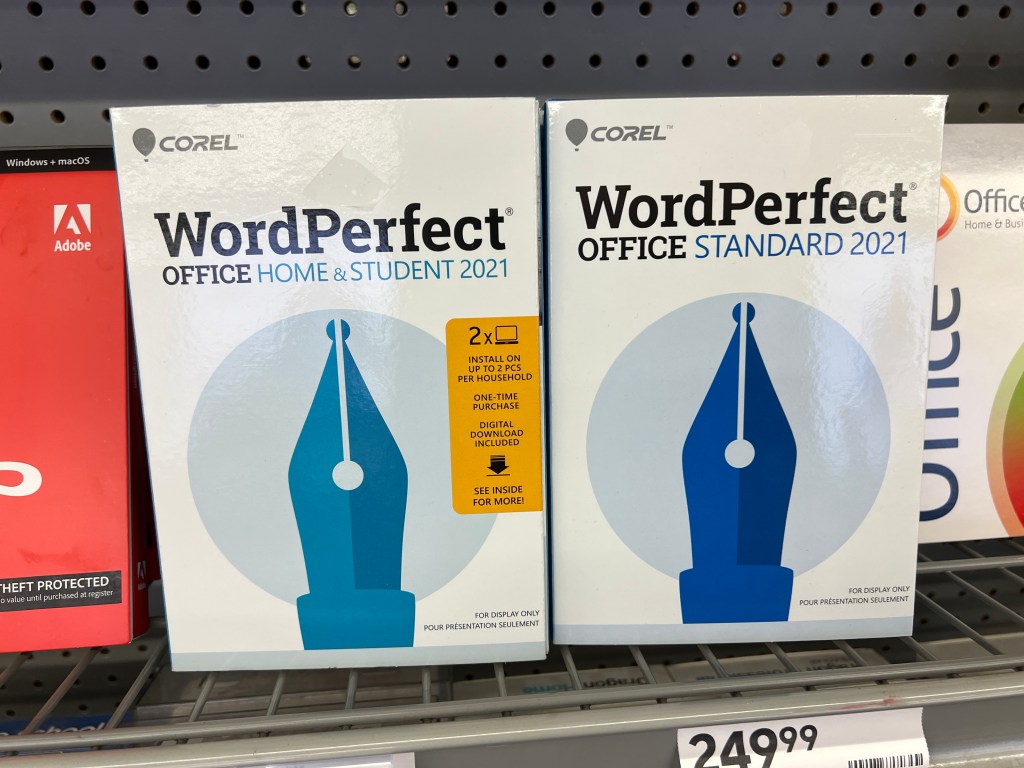
This takes me back. Ode to WordPerfect
I was walking through Staples the other day when I glanced a software rack and saw a blast from the past: WordPerfect.
For computer users of a certain age — and you gotta be in your 50s, at least — WordPerfect rings a bell. I have to say that I had no idea WordPerfect was still going. I long ago left WordPerfect behind, but it was for years in the ’80s and into the early ’90s my word processor of choice.
I wrote a lot of college papers, and a fair amount of creative writing and short stories, on WordPerfect. Seeing the name again after all these years made me nostalgic.
Back in the mid-1980s I didn’t know much about computers. I was 16 or so, and had been around them at school a bit (my high school had an Apple II) and a lot more around my father’s house. He worked on mainframe computers in the ’70s and early ’80s and brought home his first portable computer, a Kaypro, in the early ’80s. And he bought a Commodore 64 in 1983, and I spent a whole summer happily typing away on short stories and playing Flight Simulator.
He later upgraded to an IBM PC clone and I first encountered WordPerfect and another word processor, WordStar on his computer when I stayed over. He was a professional writer and editor, so he kept up with computers and wanted one at home. Dad wasn’t much for computer games, so when I played with his computer, all I had were WordPerfect, WordPress and the occasional Lexis-Nexis research portal. (That was too expensive for me to use, though.)
When Dad upgraded to a better, faster model, I got the PC, for my senior year of high school. WordPerfect and WordStar came along with it.
Even today, nearly 40 years later, I can remember what the PC looked like on the desk next to my bed. It had an amber monitor, which sat on the long, flat, chrome computer case. Inside the case were two black disk drives, which took 5 1/4 inch discs, which in those days before cheap hard drives was the way to run a computer. One floppy disk held the computer program you wanted to run. The other was what wrote your words and data to disk. It was portable, noisy and oh-so-precious. If you bent the disk, or spilled something, or left it in the heat, your data was done for.
This was all in the DOS era, where you had to learn arcane codes to get anything to work on the c> line. It’s a little like terminal mode now on my Mac or on the PC, although you really didn’t have a choice. Just to open the program required to know the right prompt. I think it’s funny that I learned DOS pretty well and also Basic, the computer language. Both of those skills are useless now, and have been ever since the Mac and then Windows took over the world.
WordPerfect. In those days without the mouse, you had to know your way around a keyboard. That wasn’t too hard if all you wanted to do was write, although you had to pay attention to where you were saving your file and if you were at all. WordPerfect, and WordStar, were phenomenally complicated programs for their time. WordPerfect had a lot more customization available, thinks like advanced formatting and something that became macros, those little keystrokes that you could use to save some typing.
But being a teen-ager, all I wanted to do was write.
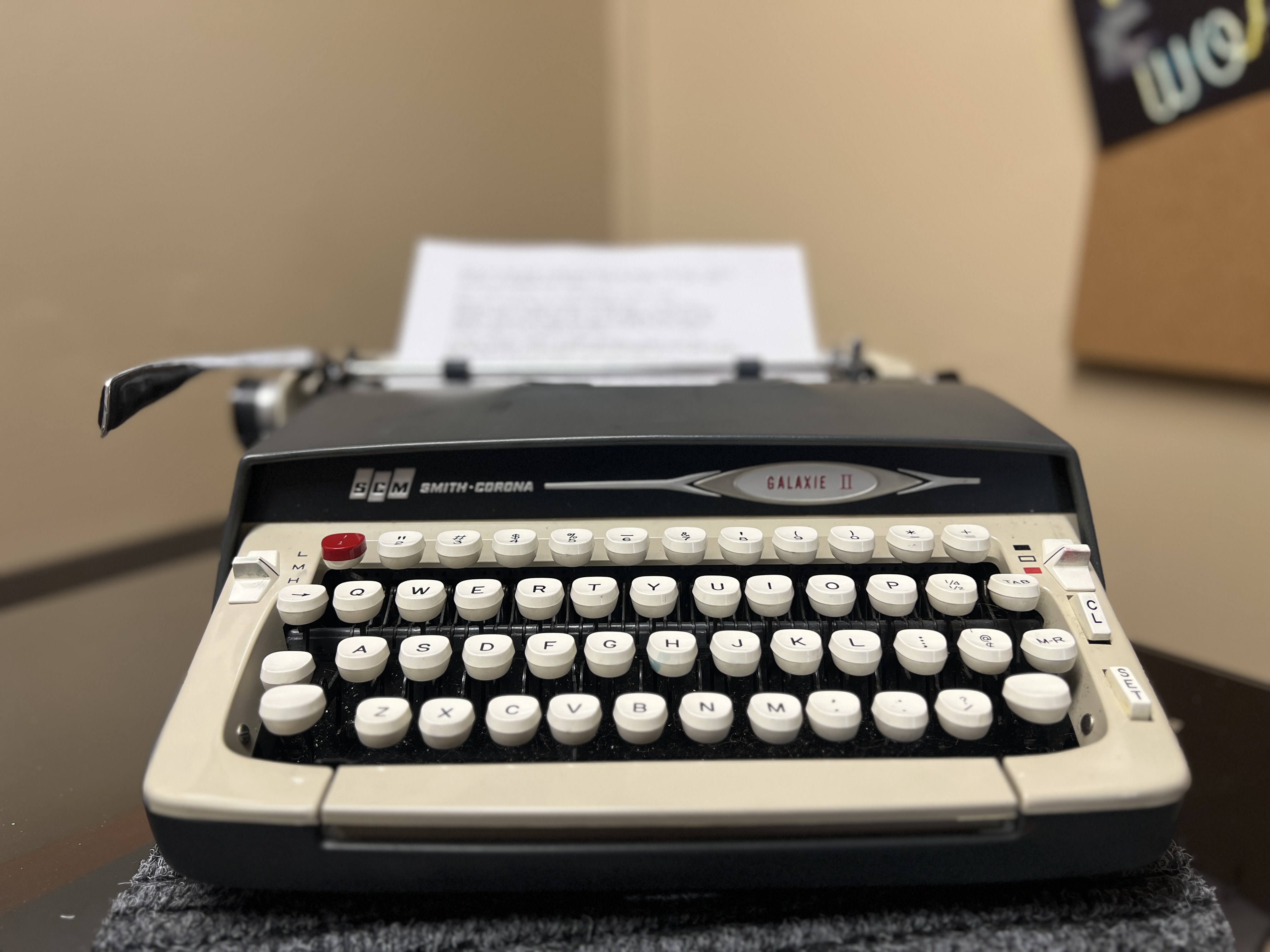
I had been typing papers and short stories for a long time, having inherited my dad’s college Smith Corona and then getting an electric typewriter for my 16th birthday. I wrote some on my dad’s Commodore 64 and then more on the PCs he got, but it wasn’t until I inherited one and could turn it on whenever I wanted that I really fell in love with writing on the computer.
And I think “fell in love” is a good way to describe it. I liked the idea of seeing my words on the screen. Even if the words and characters were all the same — there was no such thing as “what you see is what you get” — it was fascinating building my own paragraphs and pages, one after the other. I could move them around! I could write several beginnings, or middles, or ends. No eraser or correction type needed.
It was, and I still believe it today, kinda magical.
I wrote a lot in WordPerfect, not just everything for senior year of high school and then throughout college, but also short stories and attempts to write a novel and a play. I was then, and still continue, to be an all-of-the-above writer: I wrote my journal out by hand. I didn’t start writing my journal on the computer until I got out of college, which was by then on a Windows machine.
By the time the summer of 1990 rolled around, I had heard of this bright shiny object called Windows, and my next computer, a new Zeos, came with Windows 3.1 and, significantly, a full-color text editing application. I didn’t immediately fall in with Microsoft Word, either for work or for personal writing. Instead, I backed into it, using Microsoft Works and then, begrudgingly, picking up Word on sale and then, as a bundle with Microsoft Excel and, later Microsoft Access.
The bottom line is though that I left WordPerfect behind.
So did a lot of other people. Novell, which developed WordPerfect, sold it off in 1996 to Corel, which put out new versions and then began to bundle it with other Microsoft Office alternatives. Until Google came around and overturned the applecart, it apparently was a strong competitor.
I’ve gone past Word, gone past WordPerfect, WordStar, all the rest. I write a lot still, both for work and in my personal life. I use a variety of tools. I love their convenience, but I sometimes worry that the writing can get distracted by bells and whistles. That’s why I try hard to use only simple programs and apps for writing.
Just like the old days.
-
Pollen so thick it piles up
The pollen season has reached a crescendo. And I am sniffling, coughing and sneezing through it.
I have been on allergy medicine for three months, ever since I went to Florida in late February. (OK, I missed a day or two.) but in Zyrtec I trust, and except when it comes to user error, it doesn’t let me down.
That is, until this point in the season, where you can actually see the pollen. Then there is nothing I can do.
I don’t need to check the Accuweather app to see that both tree pollen and grass pollen are high. There is no amount of washer fluid that can remove the pollen coat on my windshield.
I know it won’t last. A few more weeks of sneezed and then the pollen onslaught will ease. I wlll keep taking my medicine, sneeze into my elbow, and keep lots of tissue handy.
Then it will go, at least until hayfever season.
-
Beginner’s mistake
I just lost a whole day’s worth of writing, thanks to an assumption I made about auto-saving.
A rookie mistake.
There I was, writing in my interstitial (or so) journal, beginning about 7:30 a.m. and then continuing through the early afternoon. I had probably 1,500 words, along with a draft for a blog post. I was using a new Chromebook, which I haven’t used before this weekend. But I was enjoying running it alongside my MacBook.
Then, I accidentally bumped the Chromebook’s side. Apparently that rebooted it. When it finally came back, both files and every word I had written, was gone.
To be fair, I was working in offline mode, as I wasn’t near WiFi. But I also expected the work to save every once in a while, and I also build automatic saving stops into my workflow after learning the hard way, years and years ago. I was using the Chromebook text app, not Google Docs, which I know does auto save.
Look, it’s not life-changing stuff, just notes to myself and the beginnings of a blog post. But it is a little unnerving.
Home
About Me
Journalist and writer. Loves writing, storytelling, books, typewriters. Always trying to find my line. Oh, and here’s where I am now.


Leave a Reply