-
From barns to buildings
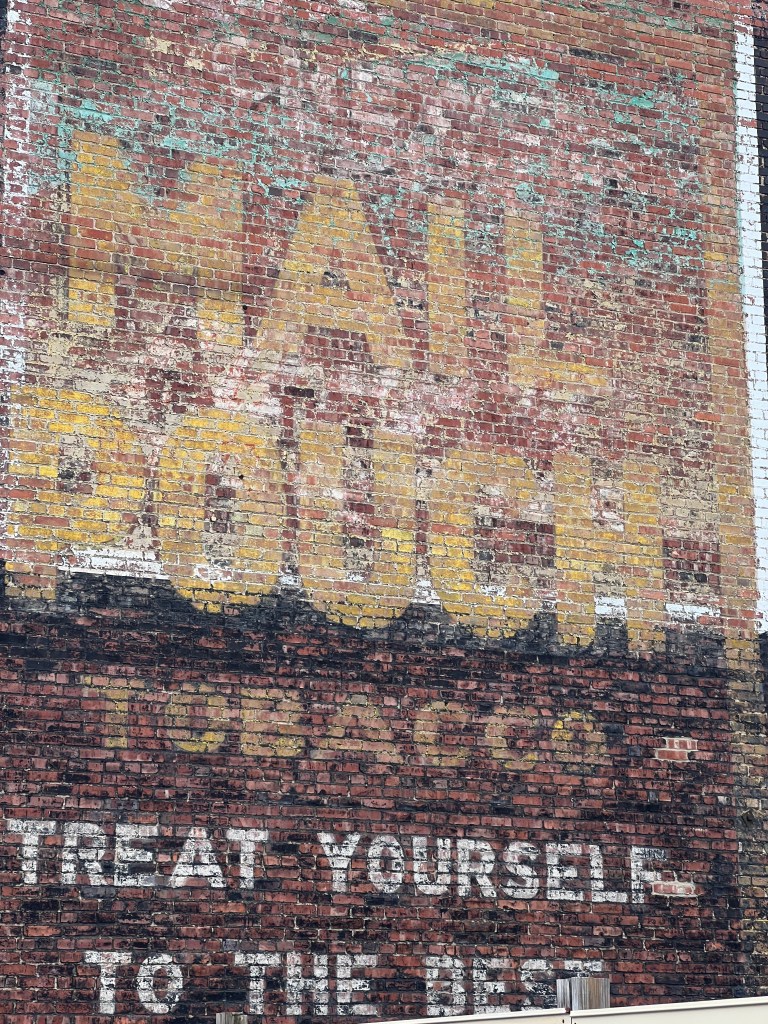
The remnants of Mail Pouch Tobacco, 30 years after the company closed. One of the features of driving through Appalachia is seeing the remnants of the extreme branding reach of Mail Pouch Tobacco.
Drive highways and byways of Pennsylvania, West Virginia and Ohio and it won’t take long to see a barn or two (or four) emblazoned with Mail Pouch Tobacco on the side. Some are more faded than others.
But today while driving in Monessen, Pennsylvania, south of Pittsburgh, I saw something ai don’t remember seeing before.
Mail Pouch on the side of a building.
Who knew?
You can look up more about Mail Pouch here. It’s a fascinating history that lasted from the 1800s until 1992. No idea how long this was here.
-
What’s your number?
This year I hit a new record: This is the longest I have had the same telephone number. Fifteen years.
That’s a big deal. I have never had the same number for more than four years, at least since I was 10 years old and living with my parents. Why? I have moved around so many times (a whole other story) that it’s only been in the last 15 years that I’ve been able hold on to the same one.
I’ve been in the 203, 619, 714, 860, 207, 845, 917, 212, 347, 718, 724 and 304 area codes. I’ve held multiple numbers in some of them — I lived in Connecticut and New York for more than half my life — but I bet that I couldn’t remember more than two of my former numbers, landline or mobile.
I got a new mobile number when I got my first iPhone, and even though I’ve moved to two states since then, I’ve kept the phone number. I’m glad I did, because even though people wonder about why I still have a New York phone number, I am happy that I do. It keeps me grounded to my past. And it’s easier to remember.
-
When ChatGPT helps me write a blog post
Not that I have any problem coming up with story ideas or even writing — for anything short of a novel I have no problem with writer’s block — but I figured it’d be interesting to see what 2023’s favorite author, ChatGPT, might have to say about what I should write about.
So I did.
I asked: “What should I write about in my blog today?” Here’s what ChatGPT had to say:
There are many interesting topics you could write about in your blog today. Here are a few ideas:
1. Share a personal story or experience that you think your readers would find interesting or relatable.
2. Write a review of a book, movie or TV show that you recently enjoyed.
3. Offer tips or advice on a topic you’re knowledgeable about, such as cooking, travel or technology.
4. Explore a current event or new story and offer you’re perspective on it.
5. Interview someone interesting in your community or industry and share their story.
6. Create a list of your favorite things, such as books, movies or podcasts, and explain why you love them.
7. Write a “how-to” post that teaches your readers something new, such as how to start a blog, how to create a budget, or how to meditate.
Remember, the key to a successful blog post is to choose a topic that you’re passionate about and that your readers will find engaging. Good luck with your writing!
Thanks, ChatGPT!
-
A return to the political conventions of old? Probably not

My view as a journalist of the balloons dropping on the 2008 Republican National Convention in St. Paul, Minnesota. Chicago was announced Tuesday as the site of the 2024 Democratic National Convention, beating out New York and Atlanta. The Republican National Convention will be held next year in Milwaukee.
The last round of conventions, held in the pandemic year of 2020, looked nothing like the conventions of the past. Both were scaled back. It remains to be seen what will happen in 2024, but with the pandemic receding from view, it’s safe to say the political conventions will party more like it’s 2016.
I don’t have a dog in the fight, but until the last few election cycles, I had paid a lot of attention to both conventions. Fair to say I was fascinated by them, both as a viewer and later as a journalist who covered on the ground the Republican National Convention in 2004 in New York and 2008 in St. Paul, Minnesota, and the 2008 Democratic National Convention in Denver.
The first convention I remember, on TV, was in 1980. I vividly remember, as a 13-year-old, being fascinated by the presidential campaign between Jimmy Carter and Ronald Reagan (and John Anderson). I couldn’t get enough of it, either reading about it in the newspaper, listening on the radio (mostly on WCBS-AM in New York, my station of choice), or on TV. It was heavily on the broadcast networks as well as an upstart cable network, CNN.
Back in those days, there was gavel-to-gavel coverage on the broadcast networks. It started in the morning and ended late at night, just like being there. I remember my grandmother being picqued by the fact that her “stories,” the soap operas that were all over TV then, were being pre-empted by Walter Cronkite, Edwin Newman and Frank Reynolds. It was fine by me. The only things I cared about in 1980 were the Boston Red Sox and baseball in general, shortwave/amateur radio and politics.
And not always in that order.There was a little drama in the 1980 RNC, with the possibility that nominee Ronald Reagan would choose former President Gerald Ford as his running mate and then the emergence of George H.W. Bush.
But looking back over the next 42 years, there’s been little drama, either on or off the screens. The candidates are selected before the convention and the state voting and other procedures are pretty much just rubber stamps. More than one observer has called the political conventions nothing more than a four-day infomercial, and I tend to agree.The major networks — ABC, CBS, NBC and Fox — long ago decided to cut back on their coverage of the political conventions. That has seemed wiser in recent years, as the rise of cable news (which has more airtime to fill and less to do it with) and then social media, has made the conventions even less relevant to the average viewer.
Even the speeches, which I thought were somewhat interesting, I don’t pay much attention to anymore. The last ones I followed closely — like being in the room with the candidates — were in 2008.
True confession: I didn’t watch in 2020, nor in 2016 nor 2012. And that’s as someone who has always been more interested in following politics, at every level, than any sport, and who covered politics on and off for the past 30+ years. On the other hand, being in person and covering the political conventions in 2004 and 2008 — and both presidential campaigns from all over the country all the way to Election Day — were among the biggest highlights of my career.
The conventions themselves probably have a lot of meaning to the delegates, as well as the host cities. There’s nothing wrong with that. But as a televised spectacle, it seems conventions’ best days have passed.
And that’s not likely to change in 2024, no matter where they are.
-
The eclipse’s 1-year countdown
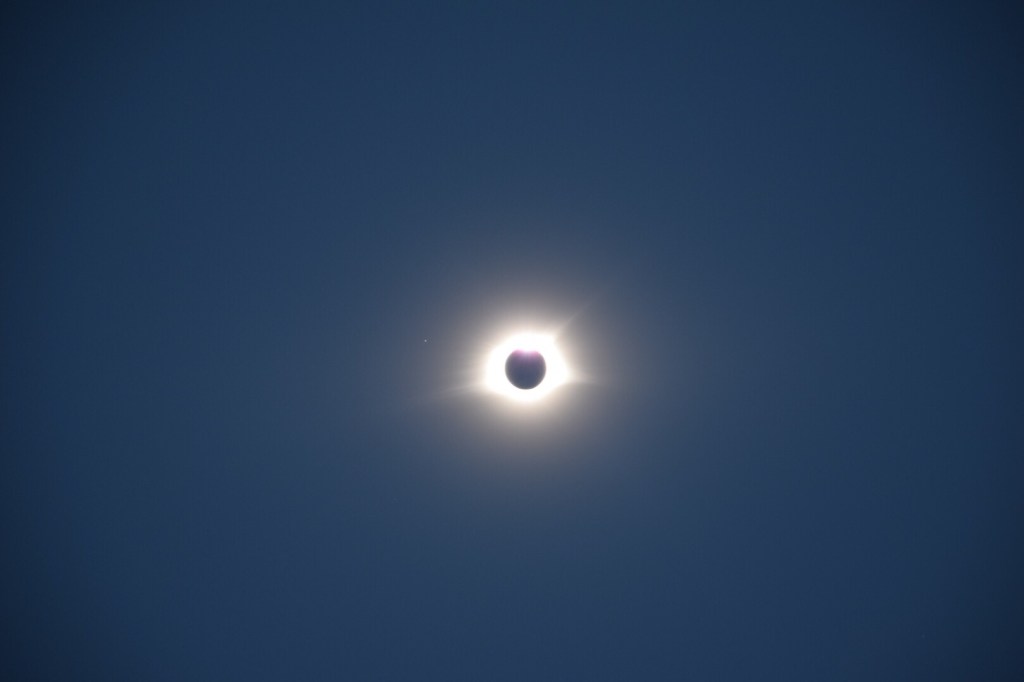
My view of the total solar eclipse on Aug. 21, 2017, in Bowling Green, Kentucky. I have been counting down the days until the April 8, 2024, total solar eclipse, which won’t be over me but it will be with a two-hour drive. Last weekend began the one-year countdown to the total solar eclipse that will be seen in a large part of the United States and Canada on April 8, 2024.
I can’t wait. You could say I’ve been waiting since the last one in the U.S., in August 2017. Because I have.
I’m an unabashed total solar eclipse geek. I’ve only seen one total eclipse, that one nearly six years ago now. But it was so spectacular that I wished I had spent my entire life up to that point going to remote parts of the world, chasing eclipses.
It was that incredible.
I had never been near a total solar eclipse before. I wasn’t even back in 2017. I drove about six hours from my home to go to Bowling Green, Kentucky, where my father and I experienced totality. It was only about a minute of totality, but it was enough to hook me.
“I can’t wait to do that again,” I told my father. He was game for the trip but didn’t really ever think about eclipses, was impressed.
Total solar eclipses only come around once every 18 months somewhere in the world, so they’re rare. With the Earth 2/3 water, living in the path of totality is even rarer.
The closest I’ve ever come was on May 10, 1994, when there was an annular solar eclipse in northern New York and northern New England. I had to work that day so I couldn’t travel — darn news biz — but my newsroom colleagues and I built pinhole cameras to safely observe the 85% obscurity above us in Bridgeport, Connecticut.
And I got to take my lunch half-hour at the maximum, shortly after 1:30 p.m. that day. I will never forget the otherworldly glow and shadows of the sun falling on downtown Bridgeport. But it in no way got dark.
It would be 23 years before I finally saw a total solar eclipse, and there was no comparison between 1994 and 2017. It was a hot day in Bowling Green, where my father and I had gone to a minor league baseball game. But gradually the sun dimmed and it got cooler, and then, around 2 p.m., the sky darkened to near twilight and the sun basically disappeared.
Looking up at that eclipse, seeing the small strands of sunlight up against the mountains of the Moon – called Baily’s Beads – I had no words. I just knew that I needed to see it again.
I’m lucky in 2024. Totality is about two hours either north or west of where I live, and I’m able to easily reach Cleveland or Columbus or Buffalo, and it will also go through where I used to live, Caribou, Maine, although that’s a much longer haul for me now.
I’ve been disappointed by a lot of astronomical events since I’ve lived in Pennsylvania, but I’m hoping the sun will be out on April 8. If not, I’ve got a few choices, although not many. It would be a drag to be so close and yet so far.
-
My motto’s always been when it’s right, it’s right
True confession: I enjoyed the song “Afternoon Delight” in the summer of 1976 when I was nine years old, even if it took me until 1981 or so before I figured out what they were singing about.
And honestly watching them perform and the little snapshot of people watching in the video catapults me back to 1976. I have a lot good memories of the ‘70s. It was my first full decade!
I watched The Starland Vocal Band summer replacement show in 1977. This song gets mocked – and lovingly parodied like in “Anchorman” – but I think it’s a pretty good pop song and SVB were strong musicians, songwriters and singers. The married couple on the right wrote “Take Me Home, Country Roads” and John Carroll, the 21-year-old on the left, has a fabulous career with Mary Chapin Carpenter and on his own.
-
Best Years, Greatest Generation
“The Best Years of Our Lives,” a movie that deserves every bit of its fame, an unflinching story about what happened after WWII (and WHILE it was happening) and one that highlights the plight of people with the emotional and physical wounds of war. It’s a story for all time because these challenges still occur, every day, even after the grand scale of the challenges for the service members after 1945.
“Best Years” hit hard, knowing what the war and its aftermath did to my grandparents’ generation.
I didn’t know it at the time, but it mirrored own family with my paternal grandfather, whose typed memoirs of his own experience from D-Day to the Bulge (and the many deaths he witnessed he could never shake) shocked us when we found it nearly 80 years later and 42 years after he died.
He was the most stoic and reserved man, a trained and decorated soldier and officer, who saw combat from D-Day to the Bulge. He returned after the war to social work and his final rotation was at a hospital, working with wounded soldiers. We know now how much emotional weight he carried til the day he died. And “Best Years” helps understand it more.
Hoagy Carmichael and Harold Russell here in this clip – Russell, who had lost his hands in WWII and not a professional actor – but a cast at its very best: Myrna Loy, Frederic March, Teresa Wright, Dana Andrews and a story by Mackinlay Kantor and a screenplay by Robert Sherwood, direction by William Wyler. An all-star team.
Best picture, best actor for March,best supporting actor – Russell is the only actor to win twice for the same role (it’s an interesting story) – and it packs a punch all these years later. Hard not to mist a bit knowing that this was real life, not just a movie.
-
The threat to journalism and a lot of white-collar work
I have been thinking a lot about ChatGPT and other AI. I am both fascinated by what is and what can be, and I am also alarmed by the threat to journalism, writing and a lot of other white-collar work. If you aren’t thinking about this seriously, then you are missing something.
This article from Axios agrees.
It won’t be long before it takes a bite out of what many of us do. Just how much of a bite, and whether it’s fatal to our careers, I don’t know.
Case in point: Journalism is the top career that AI is supposed to kill. I think it will kill a lot of the low-value work, which is actually not necessarily a bad thing. Lord knows I could do without writing up basic stories. I think it’s a big leap to think that it will be able to do the kind of work that I do, when I am working to the the top of my license (as they say).
Yet. I would start thinking of what happens next, and what you can do about it. It’s that disruptive.
It does some things well. It wrote a poem for me and it wasn’t bad. The Python script it wrote for me in 10 seconds was faster and better than the ones I did in my sabermetrics class at Boston University a few years ago. About half the headlines I ask it to write on a story I have written are better than the ones I wrote on my own.
I asked it to write fictional stories, and they are garbage right now. I asked it to write a 1000 word story in Welsh and it wrote one, and I could understand it, although it was no better than an 8th grader’s work. I asked it to write a professional bio of me and it got a lot wrong.
None of these things are gonna to stay bad forever.
-
Advice from ’90s music
“Of course you can’t become, if you only say what you would have done.” #advicefrom90smusic -
Wrecsam is special, in so many ways
https://theathletic.com/4295067/2023/03/25/wrexham-reynolds-mcelhenney-kerry-evans
Unlike most Americans, I did know exactly where Wrecsam was long before Ryan Reynolds and Rob McElhenney bought the football club there.
Wrecsam – there’s no X in the Welsh language – is full of spirit and history, like all of Cymru, the land of my ancestors and a country that I’ve grown to know and love. And since I’ve studied the Welsh language over the past several years rather intensely, you’ll pardon if I cringe a bit when the city is spelled with an X. It’s not Wrexsam.
I’m more of a South Wales kind of person, although my ancestors come from both North and South Wales (Gogledd a De Cymru). I’ve been to Cardiff and the Glamorgan Valleys multiple times and I took many of my language courses from Merthyr Tydfil and Pontypridd. They were familiar to me long before I was there because the Valley reminds a great deal of where my mother’s family is from, the Scranton/Wilkes-Barre area of Pennsylvania.
Reynolds and McElhenney didn’t have the same kinds of connections to Wales, but they have done so much good in Wrecsam since they bought the team. It’s a great story, as this Athletic article points out.
And Wrecsam will also hold a special place for me: I took a Welsh-language creative writing class there. That blew my mind, stretched me and allowed me to make a major leap in Welsh. There’s nothing like trying to be creative in a whole other language than what you’re used to. IT was working without a net, it very nearly broke my brain.
And I loved it.
It’s also helped me in my native language, sparking more creativity in English.
Home
About Me
Journalist and writer. Loves writing, storytelling, books, typewriters. Always trying to find my line. Oh, and here’s where I am now.


Leave a Reply