-
First in, first out

Here’s something that’s never happened to me before: I was the first voter into the polls this morning.
And the only voter for just about all of the time I was in there, even though it was about five or six minutes into the Election Day before I walked in.
Apparently you can get two “I voted” stickers if you are the first in.
-
It’s that time of year
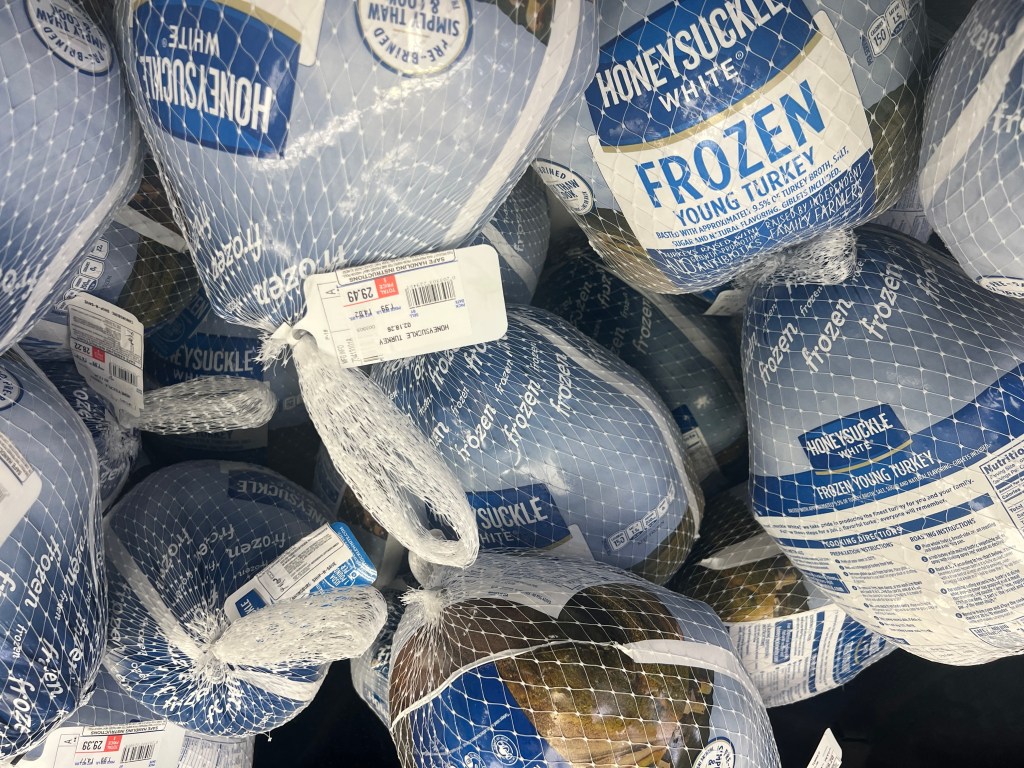
Wow, that escalated quickly. One minute, it was Halloween. The next minute, the turkeys are in the freezer case ready for Thanksgiving. Too soon.
-
Still not a fan
It’s been two years since I’ve posted “Why I’m Not a Fan of Halloween.”
Guess what? The last 24 months haven’t changed my mind.
-
A delicacy of childhood
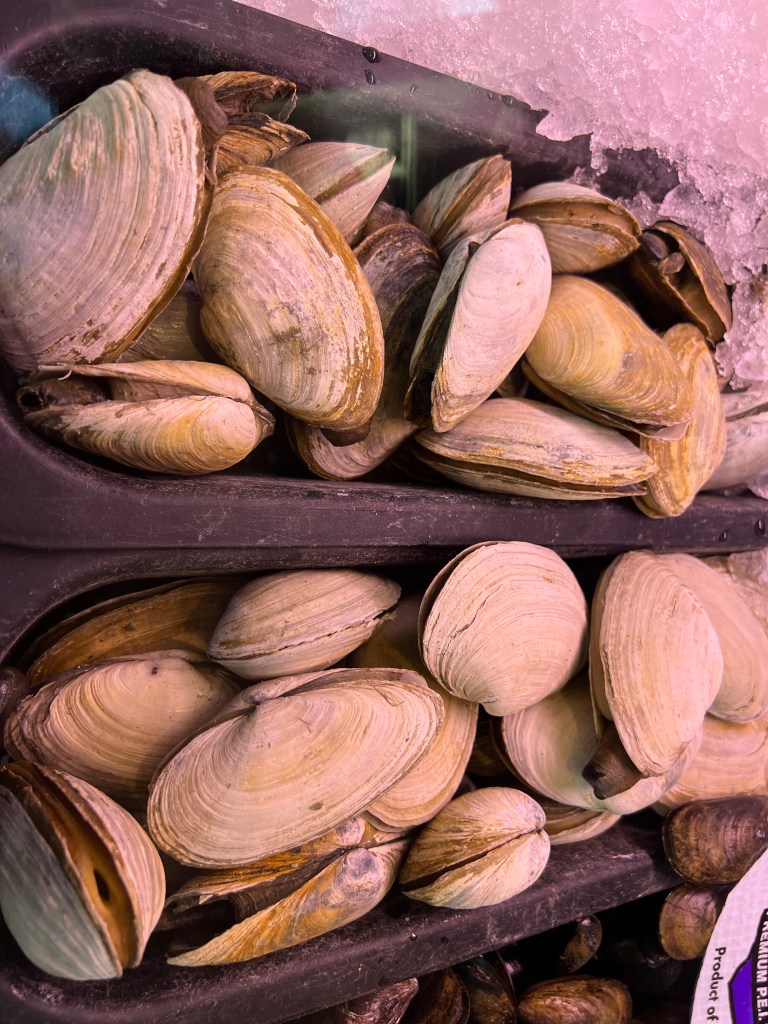
When I was growing up, this was — for me, at least — the most gourmet of meals: Steamed clams.
I loved ’em. ‘Course, it helped, growing up in the Northeast and being not only close to many restaurants that served them pretty close off the boat but also having grandparents who lived right off the Atlantic Ocean and, especially, having a fisherman next door to them who gave us thousands of clams and quite a few lobsters over the years. I even loved the broth that’s made when you steam them.
I’ve even dug for clams, and especially mussels, myself, along the Massachusetts coast, and gone out on the water with that same lobsterman, as he tended his lobster traps. It’s quite a tradition.
I haven’t had them in a long time and I still didn’t have steamed clams this trip to Massachusetts. But I saw them at the fish counter at the restaurant we went to, Jake’s Seafood Restaurant and Fish Market, at Nantasket Beach, just south of Boston. (If you’re around, it’s quite good.)
-
The Hub, from afar

Oh, hey, Boston.
-
It’s that time of year

I’m just getting my arms around the fact that Halloween is less than two weeks away, and then I go to the store and I see the Christmas decorations.
Halloween, fall, Thanksgiving and Christmas decorations, all in the same section of the store. I didn’t see any New Year’s decorations yet. At least that’s still in the stockroom.
-
Why I still write with a typewriter
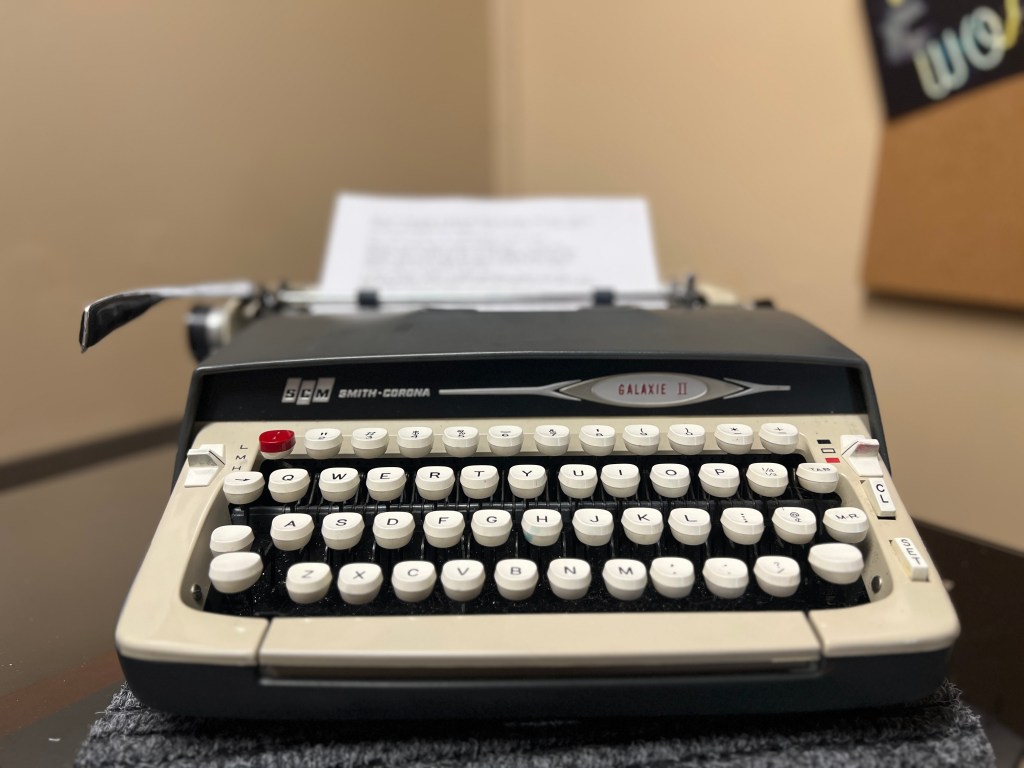
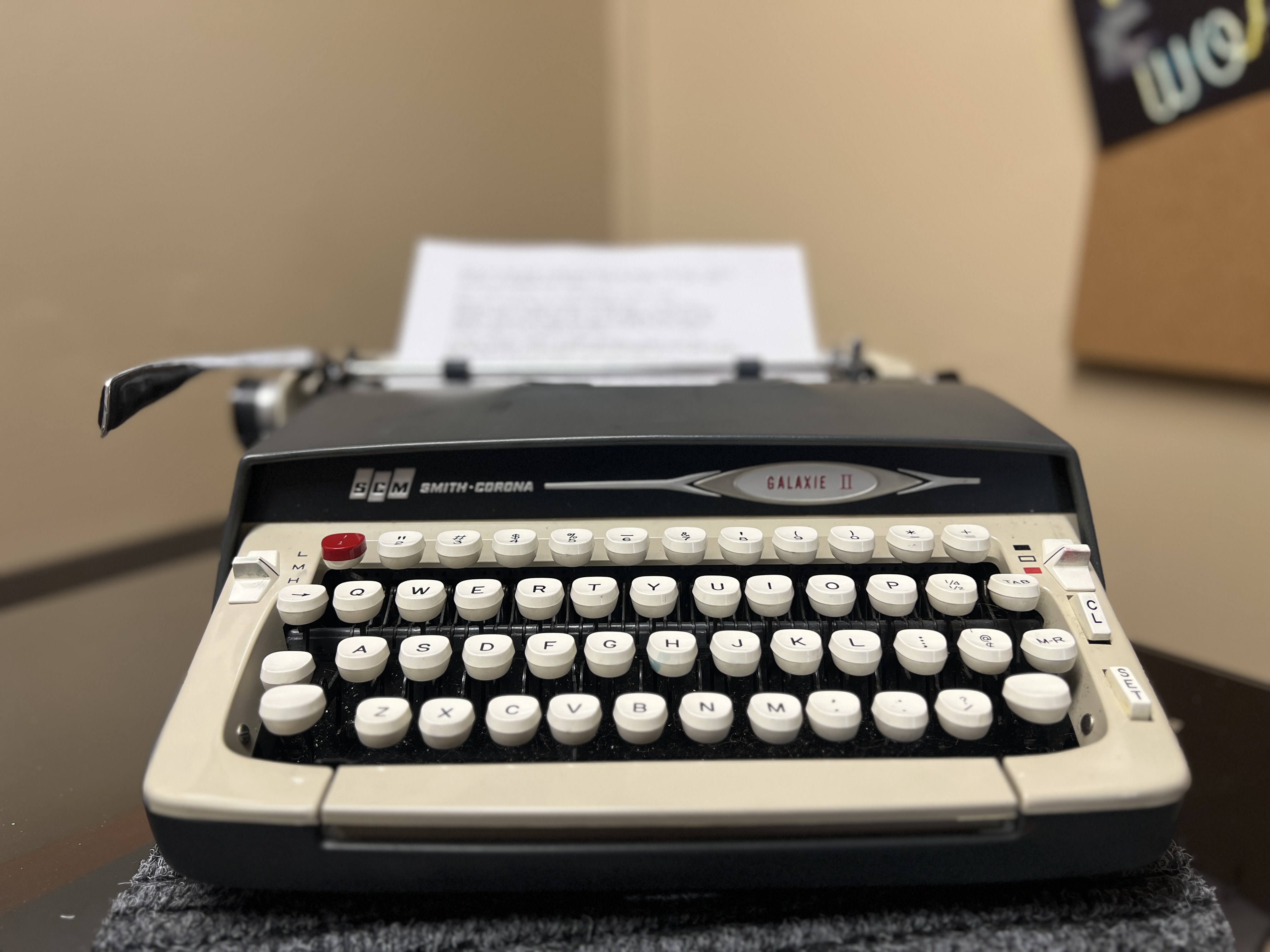
I’ve never been one for fountain pens or bespoke keyboards, being a working writer and all. But I do hold one throwback habit.
This is my 1964 Galaxie II typewriter, one in a long line of Smith Corona machines in my family. I like Smith Corona because it was my dad’s typewriter of choice, it was based in Connecticut, and it has a “1” key. Done some of my better writing in my teens and 20s on a Smith Corona.
I’ll admit, you’ll have to pry my MacBook out of my cold, dead fingers. But every once in a while, and the last several weeks, I dug out one of the typewriters I have, and burst out writing.
There’s power in those keys.
The last couple of years it’s been a 1966 Olympia SM-7 I picked up for $36 at a Pittsburgh thrift shop just before the pandemic. A classic of German engineering, just about the BMW or Benz of typers. I also have a 1954 Royal Quiet De Luxe I bought for $20 from a guy in Beaver County.
This last time around, the Olympia and Royal fell short. And since this isn’t 1968, I don’t have a typewriter repair shop nearby.
But you know what never fails me? My trusty Smith Corona.
-
Back in the New York Groove
Not my kind of music, but I’ve always liked “New York Groove.” I remember listening to it in middle school in the ’70s — not knowing who KISS was at first — and then not hearing it for a long, long time. When I left the New York metro area in my 20s, I heard it on the radio again and I was hooked all over again.
I’ve been in that New York Groove, having lived around the city for nearly half my life and having lived in New York for a decade. These lyrics often hit me as I walked in my own personal soundtrack:
To the left and to the right/buildings towering to the sky/ it’s outta sight
in the dead of nightAnd every time I walked by 3rd Avenue and 43rd Street, and it’s more times than you would think, I smiled.
Ace Frehley, who sang the lead on “New York Grove,” died this week. He was 74 and had complications from a fall.
-
Writing human vs. writing machine
My last post was about how AI-generated content was responsible for about half the new published work on the web. That’s hard enough to swallow, although predictable. So is the fact, as reported in the Graphite study, that it’s harder than ever to detect what’s AI and what’s human.
Tell me about it. I was talking about this the other day with one of my colleagues, and he said that AI could be tasked to write in my style in the prompt and poof, there it was.
I found that disappointing. Even if I wonder if I have a “style” that can be replicated. I know there are human beings, many human beings, who write better and more poetically than me.
But what sticks with me is how little human-written stuff is being valued. The Graphite study refers to a 2023 analysis from MIT that showed that AI-written content is pretty much on the level of what a human can write.
OK, I’m soft-pedaling. The study concluded:
… content generated by generative AI and augmented AI is perceived as higher quality than that produced by human experts and augmented human experts.
Yikes, is what this human writer says to that.
I have to say that I don’t have any idea what the future brings. I’ve spent my entire carer as a published writer, stretching all the way back to the ’80s. Never did I think I would be replaced by a machine. My grandkids, maybe. But not me. Now I wonder.
I’ve been concerned about this ever since ChatGPT broke out into the mainstream. (I’ve been writing about that on this blog a lot.) I’m not too optimistic when it comes to technological advances and human beings’ ability to smooth a transition. It doesn’t always go well, especially at the beginning. Just ask all the typewriter repairmen, the secretaries, the travel agents.
We don’t have to look too far: Social media and the Internet have pretty much broken society. I see no reason to think that generative AI will improve on the trajectory. To cap it off, the AI revolution could take away a large part of the job market.
What’s that going to do to writing, the form of expression that generative AI seems to be mastering? The most optimistic think there will still be an audience for human-writing. I’m hoping that’s the case. One of the things about writing that I know is that it can be deeply personal, deeply authentic. It is the axe that breaks the frozen sea between us, as Kafka put it 100-plus years ago.
What happens when that axe is wielded by generative AI?
I’m not a luddite, by any means. I see benefits in to AI in so many areas. I use it myself to help write headlines and to suggest tags, and other things that boost SEO and noticeability. I’m glad it’s here, because I know those are my writing weak points. I could see a lot of other benefits to AI.
But not when it comes to creation.
I know writers and journalists who use AI to help them prepare for interviews and to research subjects. I’ve used that a little, and it has saved a little time, in some respects. But by the time I check to make sure AI isn’t hallucinating, then I could have just done it myself. So while I’m willing to use AI to speed and deepen research, I’m still pretty wary.
But I stop well short of turning the whole creative process over to AI.
And you should, too.
That means not using AI to write letters for you, one of the longstanding ways human beings can communicate, one to another. Or using AI to create images, movies or other video. Or writing a prompt that will create a novel, a short story, a poem or an essay. Even if they’re so good these days that they can “fool” people.
There’s a line to be drawn in the sand. It’s got to be before that happens.
What are we but creative? And why would we want to give that up? Ever.
-
AI overtook human writing
There’s one thing you can be sure of with this blog: It’s written by a human being.
These days, you never know. I’ve spent almost as much time avoiding AI on the web, Google and social media as I have being on line. I haven’t figure out how to remove the AI from the top of my Google searches, though.
I say this because I just saw a study from SEO firm Graphite that said from November 2024 to May 2025, there were more AI-generated articles published per month than there were by human writers. Put another way, the number of articles written by human beings on the web went from almost 100 percent in January 2020 to just about 50% in January 2025, with the other half made up by large language models and generative AI.
But even though that has been the case, Graphite said that it thinks the AI writing boom plateaued over the past year:
We hypothesize that this is because practitioners found that AI-generated articles do not perform well in search.
Part of me wonders if they don’t perform well in search because AI is already eatings its own. That AI takes up the space that would have been used for higher-ranked (human-written) articles.
Already I know of publishers who have seen a hit in their traffic from search, because more people are getting their answers from AI. I’d like to know how AI will get its answers as publishers and outlets go out of business because of much lower traffic.
Home
About Me
Journalist and writer. Loves writing, storytelling, books, typewriters. Always trying to find my line. Oh, and here’s where I am now.


Leave a Reply