-
Bob Dylan on Creativity and Aging
Wise words from Bob Dylan here:
“As you get older, you get smarter and that can hinder you because you try to gain control over the creative impulse. Creativity is not like a freight train going down the tracks. It’s something that has to be caressed and treated with a great deal of respect. If your mind is intellectually in the way, it will stop you. You’ve got to program your brain not to think too much.”
-
Reading Wambaugh: Lessons on Life and Crime
When I was 13, I read two books I found among my relatives’ books that shocked my adolescent sensibilities. One was Dennis Smith’s “Report from Engine Co. 82,” which taught me as much about poverty and despair not so far away from where I grew up than it did about the firefighting that drew me to the book in the first place. The other was Joseph Wambaugh’s “The Choirboys,” which I happened upon as a paperback in my stepfather’s bookcase. Wambaugh died Friday.
Wambaugh, who had been an LA police officer and detective, told a different story than you saw on TV in the ‘60s and ‘70s: Sarcastic, sad, silly, sometimes violent, often full of alcohol and other vices, and full of the stresses of life and the emotional baggage carried by everyone, cops and criminals and everyone in between. There were no heroes, just people suffering from immense trauma.
I can’t say as I understood some of what I read, given the shield my parents drew over me as a kid where reality only occasionally poked out. (Not that I’m complaining about that.) But “The Choirboys” was definitely an education. And it led me to more of Wambaugh. My stepfather, a voracious reader, had several other of Wambaugh’s books, including “The Onion Field” and “The Glitter Dome,” and I devoured those. I picked up “The New Centurions” at the library. It helped by that time that I lived in southern California, so I knew some of the places that Wambaugh wrote about even if my mother wouldn’t ever let me anywhere near others.
I had no idea at the time but those books helped me understand what I would be doing in the next decade, covering crime for a few daily newspapers, spending more time with cops than I ever thought I would, and preparing me for what their working lives were like. That was helpful because I’m not a fan of true crime TV shows or movies or books, other than Raymond Chandler and Dashiell Hammett and Jim Thompson and Ross McDonald, and that’s mostly for the noir style.
I haven’t read any of Wambaugh since the ‘80s and I already can tell it’s not something I would recommend to my kids. But I respect and honor anyone who tells stories in an authentic voice, lifting a veil and bringing out the real people, and Wambaugh definitely did that.
-
Why Peter Elbow’s Writing Principles Matter Today
Before there was Julia Cameron’s Morning Pages, Natalie Goldberg’s “Writing Down the Bones” and a few years after Donald M. Murray’s writing-as-a-process, Peter Elbow espoused the concept of freewriting and voice in “Writing Without Teachers” and “Writing with Power.”
I follow a daily writing practice, that old Latin aphorism, never a day without a line. Never a day without many lines, most of which have nothing to do with making a living nor may ever see the light of day. I use some of Elbow’s principles just about every time I write. Writing is a process of exploration, of finding your voice, as much as it is a mode of communication, and the two are intrinsically linked. That was one of the key teachings of Peter Elbow.
Elbow wasn’t my entry into free writing. That was picking up “Writing Down the Bones” at a bookstore when I was on vacation in Maine in March 1987, and devouring the book on a snowy evening and going into Ellsworth to grab as many spiral-bound notebooks as I could find and filling page by page, notebook by notebook, with my free writing every day ever since.
Most people who know me either love or hate the fact that when I get into something, I really get into it. So it was with this. I got home and began to find and devour everything I could about writing, finding Murray’s work and Roy Peter Clark and Donald Fry’s “Coaching Writers” and, “Writing without Teachers,” among others.
Elbow was more academic than Goldberg, but as evangelical as Murray. Donald M. Murray, who was both a top flight academic AND a Pulitzer Prize-winning journalist, loomed larger as an influence because he understood both worlds.
Elbow wrote a lot about the process and lowering the bar at the beginning.
“Make some words, whatever they are, and then grab hold of that line and reel in as hard as you can. Afterwards you can throw away lousy beginnings and make new ones. This is the quickest way to get into good writing,” he wrote.
There’s something basic and yet brilliant in this advice. And in this:
“The habit of compulsive, premature editing doesn’t just make writing hard. It also makes writing dead. Your voice is damped out by all the interruptions, changes, and hesitations between the consciousness and the page. In your natural way of producing words there is a sound, a texture, a rhythm — a voice — which is the main source of power in your writing. I don’t know how it works, but this voice is the force that will make a reader listen to you … But if you abandon it, you’ll likely never have a voice and never be heard.”
-
Remembering Rick Buckler: The Jam’s Impact on Music
Really sad to learn of the passing of Rick Buckler, the drummer of one of my favorite bands ever, The Jam. (The Jam and The Band.) The older I get, the harder it is to see artists I looked up to as only being 10 or so years older than me have been passing over the last several years: Ranking Roger of The Beat, Terry Hall of The Specials, Andy Fletcher of Depeche Mode, Mark Hollis of Talk Talk are the ones who come to mind off the bat.
And now one of the three members of The Jam. I honestly thought those three angry young men from Woking were immortal. Paul Weller’s lyrics and attitudes shaped my youth. I dressed like a Mod — dress shirt, thin tie, jacket — from 8th grade onward where, at least at Coronado (California) High School in the early ’80s, The Jam were one of the most popular bands.
“Town Called Malice” is by far the best known Jam song, and unlike some super-popular songs of bands I grew up with (looking at you R.E.M. and Tears For Fears), I haven’t looked askance at it. It’s as brilliant in 2025 as it was when it came out in my first year of high school. Words to live by.
But it’s hardly the only immortal Jam song. Six albums, from 1976 to 1982, with Weller’s lyrics and soaring guitar, Bruce Foxton’s sublime and underrated bass, and Buckler’s driving drum. My grandmother bought me The Jam’s double-LP best-of “Snap” back in ’84 when I moved back to Connecticut and I can’t think of one subpar track.
Weller, yes. But Foxton and Buckler, too: You hear how important they both were to “In the City,” “Going Underground,” “That’s Entertainment,” “The Man in the Corner Shop” and one of the greatest mic drops in popular music, their final single, “Beat Surrender.”
Like a lot of bands, The Jam didn’t end happily. There were no reunions, ever. Weller had other things he wanted to do (The Style Council and hits in every decade from the ’70s til now) and left The Jam abruptly. He also distanced himself from Foxton and especially Buckler — cut them dead is how The Guardian put it — and the ensuing years were up and down for Buckler.
I was 11 when my one and only time to see The Jam occurred, about a year before I hard heard of them and way too young anyway: They were at the close to my hometown, back in the ’70s. But I know a few people who did see them, and I’m as jealous as I would be for people who had seen The Beatles or The Band back in the day. I was too young for them, too.
-
Visiting Paddington Station: Memories and Movies
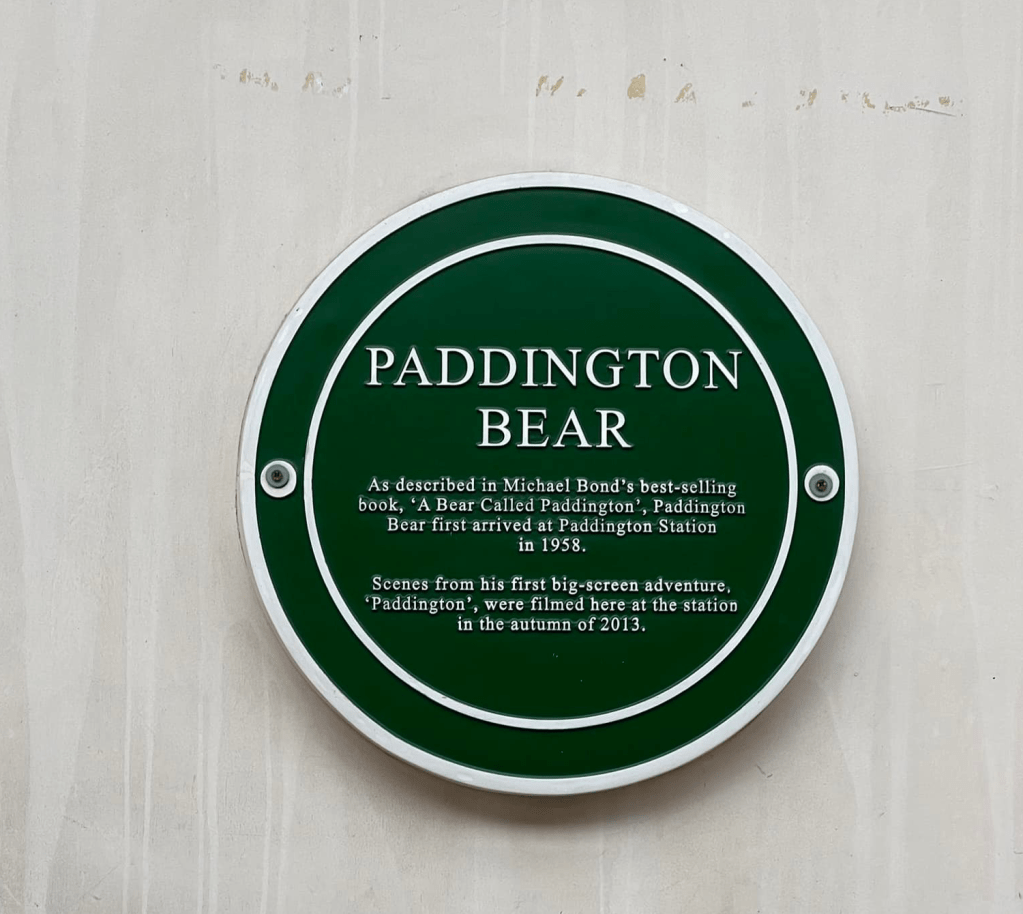
Several awesome things happened in 1958. One was the beginning of the beloved children’s series, “A Bear Called Paddington.”
Got to see “Paddington in Peru” at the movie theatre, I am revisiting saying goodbye to the Paddington statue at Paddington Station in my last moments in London last time around.
I love Paddington the books, Paddington the movies (the first two were sublime and “Peru” was better than I was expecting), and Paddington the Railroad Station. Why the station? Well, they filmed part of the first movie there of course. Plus, Paddington is how you get from Heathrow to Wales. I’ve been to Paddington Station six times, actually, and it was nice to see a glimpse of the station again in this movie, too.
They went and moved the Paddington Statue between 2020 when I was there just before Covid-19 and 2022 when I was there last. And frankly, it was harder to find. Not the best way to treat a Marmalade-loving bear, is it?
Anyway, we loved the movie and it’s great. Missed Sally Hawkins as Mrs. Brown, but everything else was as it should be.
-
Why ‘Up on Cripple Creek’ is a lot more complex than you think
Still thinking about the passing this week of Garth Hudson, the last surviving member of one of my favorites, The Band.
This gem is from a ’90s documentary about The Band, and how they made “Up on Cripple Creek.” I’m fascinated by the creative process and how it all comes together, especially in writing but also in music. This focuses mostly on the great Levon Helm and Garth Hudson, whose “funky Clavinet” stars on this track. But Robbie Robertson picks apart the tracks and what you don’t hear too much is the merry-go-round music that Garth Hudson is playing in between the Clavinet.
“Quick on the draw,” Robertson smiles.
It’s only about five minutes but it’s worth every moment.
-
RIP, Garth Hudson
I didn’t plan on posting about The Band two days in a row, but its last member, Garth Hudson, died today in Woodstock, New York. They’re having a heck of a concert in Heaven with Levon, Robbie, Richard, Rick and Garth.
We have a lot to thank Garth for: recording and saving all of the basement tapes with Dylan; being solely responsible for the emergence of the funky wah-wah pedal (first in this song); and helping to elevate a bar band to immortality. As Garth and the late, great Levon Helm pointed out in a documentary from the ‘90s, there weren’t a lot of rules back then so they kept trying things.
(A useful creative lesson, actually.)
My everlasting memory of Garth Hudson comes from this performance on The Ed Sullivan Show in 1969: At 1:40, you see him in his element.
It’s pure joy.
-
‘A Farewell to Arms’

Photo by Element5 Digital on Pexels.com One of the art works that went into the public domain on Jan. 1 is “A Farewell to Arms,” the World War I epic by Ernest Hemingway that was first published in 1929. I actually own a hardcover first edition, sans dust jacket, of “A Farewell to Arms,” which I picked up for a dollar in the ‘80s when I went to a library used book sale in Connecticut.
I didn’t know it was a first edition until, one day a few weeks later, I picked it up and noticed it wasn’t a reprint and it was in great condition for being almost as old as my grandparents. No one else noticed either, although that was in the day when book dealers and others didn’t have instant access to databases on their iPhones.
Turns out I’ve read a lot from 1929, looking at this list. And some of the Marx Brothers’ best, too.
-
A personal snow map
What a really oddly personal snow map. The orange blotches of intensity and projected snow depth — in the Hudson Valley, Connecticut, and northern Maine — are hitting exactly where I spent much of my life. And where most of my thoughts go, even now. #FunWithData
-
Just as imagined

Photo by Zelch Csaba on Pexels.com I’ll never forget the first time I saw Saturn in a telescope, and all I could think about is, that doesn’t look real, it looks like a picture book. I’m by no means an astronomer but I enjoy looking up at the sky. I agree with the guy I ran into last year when were both chasing the comet: There’s so much wonder in the world and you can see God’s hand in everything.
One of the best parts of living in northern Maine along the Canadian border was the lack of outside light and the ability to see the Milky Way and the Northern Lights much more often.
Home
About Me
Journalist and writer. Loves writing, storytelling, books, typewriters. Always trying to find my line. Oh, and here’s where I am now.
 Nows and Forevers
Leave a comment