-
Road safety
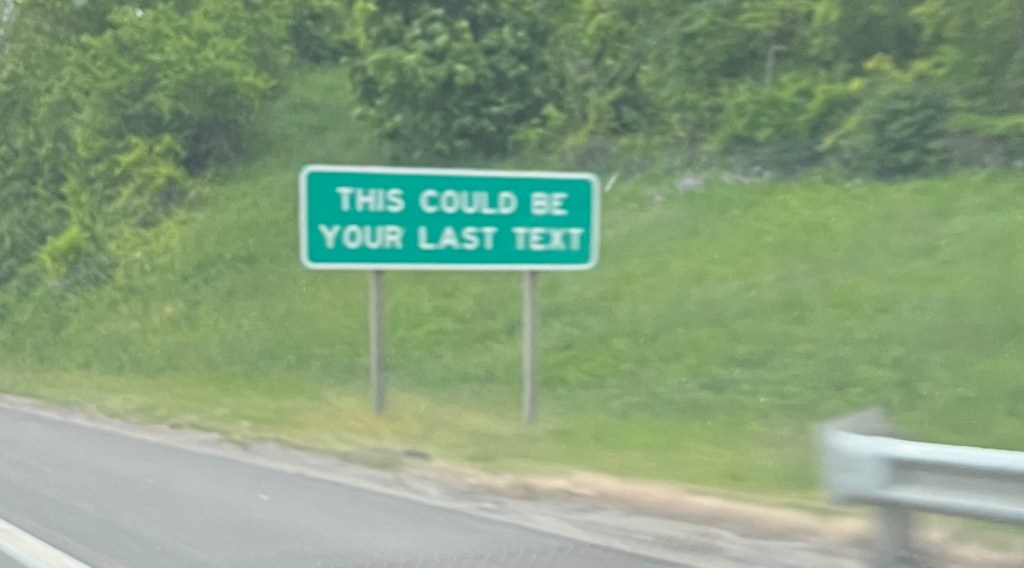
Seen on the road a few days ago: “This could be your last text.”
Passed this sign several times on my trip to Ohio. It’s apparently part of a road safety campaign that also includes an electronic tally of how many days since the last serious crash on that stretch of road.
Four days on one section, 247 for another.
-
The road rarely taken
Somewhere on Interstate 70 in Ohio
I’ve driven this side of Interstate 70 only a handful of times in my life. But they’ve been for significant reasons, so some of the memories remain, no matter how long ago. It’s funny how that works.
On the trip out of Pennsylvania, and for much of the trip to Columbus, it doesn’t look too much different than Pennsylvania. Miles and miles of, well, miles and miles. Eastern Ohio, at least, here, isn’t flat. It is the Midwest, no doubt. But that’s really a glance at the map instead of the look out the window. It’s remarkably green and hilly. If it weren’t for the unfamiliar and unmistakably Ohio names, I could be anywhere east of here.
It’s only when you get past Columbus do you reallize you’re no longer in the Northeast. That’s where the land flattens, the farmland starts to grow, and all the other parts of the countryside morph into what East and West Coasters call flyover country.
I’ve certainly flown over it a lot, both for business and personal reasons. It’s by this time, when I fly out of New York, that I am not really looking outside anymore. But now that I live in Flyover Country, I have a different perspective.
This stretch of road, where I ride now, reminds me of a part of my life, long gone, but also pretty important even though I didn’t know it at the time.
My first time here was in September 1981, when my family left New England to drive to my uncle’s wedding in Indianapolis, where his bride grew up. The trip from Connecticut to Scranton wasn’t that remarkable. I have spent more than half my life living in that stretch from central Connecticut to the Hudson Valley of New York, and I knew it well even then as a 12-year-old. And I spent a lot of time in the car as a kid, visiting my maternal relatives in the Scranton area.
But Pennsylvania, that vast commonwealth, I had never driven the length of it all the way before. I don’t remember a ton, but I do recall seeing oil derricks off the highway, poking and rhymthically swinging up and down.
I was fascinated by that. It isn’t something you see where I grew up.
We stayed the first night in Cambridge, Ohio, which my grandfather told me was near the hometown of John Glenn, the famous astronaut. That was cool, but other than that I don’t remember anything else of the trip. At least not in Ohio.
The Buckeye State was, through no fault of its own, unremarkable. What I remember next is crossing over into Indiana, and a sign that said it doesn’t follow daylight savings time. It’s funny, again, how you remember that.
I was only in Indianapolis for four days, and we left that Monday and drove all the way back home after the wedding so that I could start school that Tuesday and my mom could go back to work. I had no idea that I would be going that way again, only four months later, when my mother, stepfather and I drove all the way across the country to our new home in San Diego in January 1982.
That became a signature event in my life, and it partially began with this stretch of road, from Connecticut through Ohio and a great way on Interstate 70.
That was 41 years ago. It took a long time for me to come back to Ohio. I flew over it a lot, but didn’t drive I-70 here until the spring of 2009, when my father and I visited the Air Force Museum in Dayton, and again in 2017 when he and I went to Hamvention, a big amateur radio convention they hold here annually.
And that’s why I’m there again, on my own for the first time when I drive this way, in 2023. -
Trapper Keeper, revived

A 2023 Trapper Keeper, just like I had in 1980. Some things from the ’70s and ’80s play better in 2023 than others. Looks like the Trapper Keeper might have been better in the past.
It pains me to say that. I loved my Trapper Keeper, which I brought proudly to Griswold Junior High School in September 1980. My dad bought it for me, probably at either Bradlees or Caldor, along with extra folders for each of my 8th grade classes. It kept me relatively organized that year, as I remember. And I wasn’t the only one: You could hear a lot of Velcro open and close all around me in every class.
I moved to southern California for high school and promptly forgot about my Trapper Keeper. Maybe it wasn’t cool. Maybe I had too many classes to take, with too much paperwork. I liked them and now to change up organizing systems.
Between the early ’80s and two years ago, I had really not thought about or seen Trapper Keepers. I have bought school supplies for my kids for a long time now. But it wasn’t until two years ago, while getting stuff at Staples that I saw the OG Trapper Keeper again.
I couldn’t get my kids to bite. But I couldn’t help picking one up and opening it for old time’s sake. But it wasn’t something I was gonna buy.
Apparently a lot of people felt that way, at least on my corner of the world. They display stand remained full, and then moved to the back, then a few months ago moved to clearance. The price for the longest time was $10 for the binder and three folders. They had all the colors I remember.
Yesterday, though, as I went to pick up something at my local Staples, I walked by the clearance table. They were marked down to $3 each.
I couldn’t resist. I picked up this green one. It’s the same color I had in 1980. Funny how you remember that.
I have no idea what I will do with it. My Welsh classes are over, and I don’t have another class that I take notes for. In fact, professionally, I usually take notes on a computer because it’s faster and easier to collate. It’s rare that I use a reporter’s notebook.
I don’t think I can I treat my kids in a Trapper Keeper, not now at the end of school nor next September.
And that’s a shame. 13-year-old me had a good school year with his green Trapper Keeper.
-
When you live in the worst city in America, but you disagree

Another year where I don’t live in any of the top 10 “Best Places to Live.” But I have lived in what one of those high-profile rankings called the worst.
At least when it came to another annual outlook, from Money magazine.
Waterbury, Connecticut, received the bottom-ranking, No. 300 out of 300 cities ranked, not once but twice when I lived there: 1991 and 1992. That was an affront to the city of 110,000, which is tucked away in the hills of Connecticut between Boston and New York City and has a large place in history. The Brass City, as it was called, was deeply upset by this indignity.
As The New York Times put it in an article after the second ranking: “Wounded Waterbury: No Place to Go But Up.”
I was living in Waterbury at the time and was an editor at the daily newspaper, the Waterbury Republican-American. It was, in fact, my first professional newspaper job. I remember how angry people were, in and out of the newsroom. There was a front-page reaction story, and an editorial about how wrong Money was. As I remember, it fed stories and the editorial page for a long time.
I thought then, and now, that Waterbury was getting a raw deal.
It was easy back then to dump on the industrial cities and towns of Connecticut, not only Waterbury but also Bridgeport, Torrington, New Britain, Naugatuck, Danbury and Meriden. The de-industrialization of the United States in the ’70s and ’80s left a lot of empty buildings and economic pain in its wake, and I saw it firsthand in Connecticut, which is my home state and where, between Connecticut and New York, I’ve spent half my life.
So it was easy to say that Waterbury had seen better days, especially in the late ’80s and early ’90s. Drivers passing by Interstate 84, which cuts through Waterbury, probably had three overwhelming impressions back then: The big yellow cross of Holy Land USA that overlooked the eastern part of the city, the clock tower (modeled after Sienna’s and part of American literature, mentioned in “A Death of a Salesman”), and then the sprawling ruins of the brass plant that took up so much acreage in the middle of Waterbury.
Yet few people would have given Waterbury higher marks over Bridgeport, about 20 miles down Route 8 and along the coast. Bridgeport had filed for bankruptcy, had been hit by crime and economic decline, and was an even more inviting target. (Bridgeport’s woes even made a laugh line or two in “Cheers,” where Cliff Clavin was played by a Bridgeport native, John Ratzenberger.) Yet Waterbury came up at the end of the line in the Money magazine rankings, not just once but twice.
I’ve thought about Waterbury every time I see a “best/worst” cities ranking. I don’t have a problem with calling out the “best” of the many ways to look at a city or metro region. That’s a point of pride for many people, and it’s boring just to name San Diego No. 1 all the time. But the “worst” ranking, for Waterbury, was the worst, in my book.
I’ve got a fond spot in my heart for Waterbury. It’s near where I grew up and I drove by there a lot, before and after I worked there. Waterbury doesn’t loom as large for me as New Haven does, but that’s because my parents both worked in New Haven and it’s where we naturally gravitated.
I gained a better appreciation of it when I worked there, and got to know many of its people and understood its place in history. It was a great news city, then and now. The Waterbury Republican won a Pulitzer Prize for Public Service in 1940 covering mayoral corruption, of which it unfortunately has a history. Lots of stuff happened, good and bad, in Waterbury. And a colleague and friend of mine told me long ago that just about everything that happened in the world had a Waterbury connection. (He was right, but that’s another story.)
I moved out of Waterbury and then the Naugatuck River Valley a few years later, and I have to say I haven’t been back as much as I would like. But Waterbury has often shown up in my life, even today, where I often professionally run into people who either were born and grew up there or have it on their resume. That’s not just where I live and work now, but all around the country. It’s amazing where you find Waterbury people.
Waterbury itself has changed, too. The former manufacturing plants, which would sometimes catch fire and were almost always something people remembered about Waterbury, are long gone. They’ve been replaced for more than 20 years by a retail and entertainment complex known as Brass Mill Center that makes Waterbury a place people go.
And in the end, more than 30 years later, I still don’t understand why Waterbury struck the bottom of the list two years in a row. I’ve traveled all over this country and found places that you would want to live, and others that maybe you wouldn’t. Things that you can’t necessarily find in a ranking or an algorithm. Just about everywhere has its good points and bad points.
Waterbury was just being kicked when it was down.
-
Allergic to everything green
Protip: Don’t ever stop taking allergy medication until the season is through.
I learned this lesson the hard way, just recently. I had run out of my Zyrtec — my entire household takes it from March through June — and I hadn’t gotten to the store by the time evening came around.
No worries, I thought. Zyrtec takes a while to build up so maybe missing a day won’t be so bad. There will still be some left anti-allergy-ness left in me, right?
I woke up sneezing, coughing and with a sore throat.
Not for the first time, my lack of medical knowledge and common sense failed me.
I rushed out and got a refill, which took another few days before I was out of the watery eye/sneezing/coughing zone. But it got me thinking about how dependent I’ve become on my allergy meds.
From the moment I remember drawing a breath — decades and decades ago — I’ve had allergies. Spring was my least favorite season because it would signify how miserably sick I was going to be for several weeks running. My eyes would water and burn. My nose would keep running, and I’d have to carry a small box of Kleenex with me. Sometimes my throat would hurt. And I’d cough, for weeks on end.
Back then, when I was a kid, there wasn’t much of a chance to treat it, either. I would take Benadryl, which would make me sleepy, or another anti-histamine. Doctors would not have any idea what to do, other than to soldier through it and wait for June.
“You’re basically allergic to everything green,” one doctor told me. Having childhood asthma didn’t help, either.
I went to an allergist, but there wasn’t much to do. It wasn’t until the ’90s when Zyrtec (cetizirine) came out that I began to get relief, although it took a few years before I got a prescription. And then it wasn’t until 2007 when it began to be available without a prescription.
Now, I take it from March through June and then again in hay fever season, August and September. I know it takes time to build up in your system, so I get out ahead of any potential pollen and allergen by taking it long before the buds begin. This year, I was in Florida in late February so I started even earlier than I would.
So far in my second course of allergy medicine, I’m doing OK. I woke up this morning with a fit of sneezing and coughing, but that went away. I expect that it will only be another month or so and then I’ll be able to stop the meds until ragweed season, which I started getting allergic to about a decade ago.
Can’t wait.
-
‘The greatest pilot anyone had ever seen’
Sixty years ago today, immortalized in one of my favorite flicks, “The Right Stuff,” and one of my fav movie endings ever, with the actual film of Faith 7’s launch and the late, great Levon Helm’s voiceover:
“On that glorious day in May 15, 1963, Gordon Cooper went higher, farther, and faster than any other American. He was the last American ever to go into space alone. And, for a brief moment, Gordo Cooper became the greatest pilot anyone had ever seen.”
And if you haven’t ever seen it, “The Right Stuff” has Sam Shepard, Ed Harris, Fred Ward, Dennis Quaid, Harry Shearer, Jeff Goldblum, Levon Helm and Eric Sevareid in an epic and true adventure, beautifully acted, written and filmed. Walking around the Mercury launchpads when I visited Cape Canaveral was truly a heady experience.
When I saw this movie with my stepfather at the Mission Valley theatres in San DIego in the fall of ‘83, after devouring Tom Wolfe’s book that summer, the Mercury program was only 20 years before and all of the 7 but Grissom were still alive. Now they are all gone, and even a number of the actors – Shepard, Helm, Sevareid, and last year, Fred Ward.
I highly recommend “The Right Stuff,” which was directed by Philip Kaufman. and this clip uses a lot of the Faith 7 footage to great effect. And Bill Conti’s score, along with the credits rolling as Faith 7 streaks upward through the sky, it’s one of the most rousing endings to a movie I’ve ever seen.
-
Missing Eurovision
Eurovision. I’m sorry I missed it this year.
The last two years I have watched the live telecast from here in the United States, both times live updating with my European friends via WhatsApp where the contest went late in to the night but was over around dinner time here on the East Coast.
I even got my kids to watch and root for their favorites. We had fun.
But this year I knew Eurovision was going on and so wanted to see it, but life got in the way. I spent this whole afternoon not in front of the TV or glued to Twitter – I am not doing that anymore – but instead shuttling kids from place to place or spending time with the family. I didn’t even have a spare moment to give to Eurovision, which saddens me.
It’s pretty fun.
-
The West Wing bipartisanship
“The West Wing” lost me after its second year, when my personal and work life became much more complicated and busy. But I got a chance to see the last year and it was fascinating to see how it was being transitioned. I would have liked to see the first term of President Santos.
And this is a great scene, with Jimmy Smits and Alan Alda showing what bipartisanship really looks like. Too bad it’s fiction.
Home
About Me
Journalist and writer. Loves writing, storytelling, books, typewriters. Always trying to find my line. Oh, and here’s where I am now.


Leave a Reply